Andijan · Sights
Babur Museum and Babur Park, Andijan
The Babur museum in Andijan, in the old citadel where the founder of the Mughal empire spent his youth, and Babur Park on the hill outside the city, with his life story and how to visit.
Andijan is the birthplace of Babur (1483–1530), founder of the Mughal empire of India. In the old citadel, a museum in a reconstructed madrasah tells his life story, with manuscripts and miniatures of the Baburnama. On a hill outside the city, Babur Park has a memorial and views over the valley. Allow 1–2 hours for both.
Babur
Zahir ud-din Muhammad Babur was born in Andijan in 1483. On his father’s side he was a descendant of Timur; on his mother’s side, of Genghis Khan, through his grandfather Yunus Khan, whose tomb stands in Tashkent. At the age of eleven he inherited the throne of Fergana, then a small Timurid principality with Andijan as its capital.
His youth was spent in constant struggle: he captured Samarkand three times and lost it each time, and was finally driven from Central Asia by the Uzbek ruler Muhammad Shaybani. He took Kabul in 1504 and from there turned to India. In 1526, at the battle of Panipat, he defeated the Sultan of Delhi and founded the Mughal empire, which would rule much of the Indian subcontinent for over three centuries and build monuments such as the Taj Mahal. Babur died in Agra in 1530 and was buried, as he wished, in a garden in Kabul.
The Baburnama
Babur is remembered not only as a conqueror but as a writer. His memoirs, the Baburnama, written in Chagatai Turkic, are one of the great autobiographies of world literature. Frank, observant and full of detail, they describe battles and politics but also the gardens, fruits, birds, landscapes and people of Fergana, Samarkand, Kabul and India. He wrote lovingly about Andijan and its melons, grapes and water. He also wrote poetry, both in Turkic and Persian.
The museum
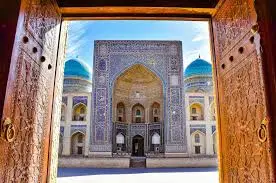
The museum is located in the area of the old citadel (ark) of Andijan, where Babur spent his childhood, in a building styled as a madrasah. Exhibits tell the story of his life and of the Mughal dynasty, with copies of Baburnama miniatures, manuscripts, maps of his campaigns, portraits of his descendants, from Humayun and Akbar to Shah Jahan, and objects related to the culture of his time. There is also material on Babur’s poetry and the literary heritage of Andijan.
Nearby stands the Juma mosque of Andijan, a 19th-century complex with a madrasah and minaret, one of the few historic buildings in the city that survived the earthquake of 1902.
Babur Park
On a hill a short drive outside Andijan lies Babur Park (Bog’i Bobur), a large memorial park created in the 1990s. It includes a symbolic tomb of Babur, with soil said to be brought from his grave in Kabul, a museum building, gardens and viewpoints overlooking the city and the Fergana Valley. It is a popular place for local families and wedding parties, especially on weekends.
Visiting
Location: the museum is in the centre of Andijan, in the eastern Fergana Valley; Babur Park is a short drive out of the city.
Tickets: small entrance fees.
Time needed: 1–2 hours for both.
Tips: read a few pages of the Baburnama before you go; his descriptions of Andijan make the visit much richer. Andijan is near the border with Kyrgyzstan and makes a good stop on the way to or from Osh. See how to get to the Fergana Valley and our Fergana Valley itinerary.
Babur’s legacy in Uzbekistan
Babur is honoured in Uzbekistan as a great statesman and poet. Streets, parks and schools bear his name, and his statue stands in Andijan and Tashkent. For visitors, his story connects the Timurid monuments of Samarkand with the Mughal monuments of India, and the Amir Timur Museum in Tashkent places him within the wider history of Timur’s descendants.
Frequently asked questions
Who was Babur?
A descendant of Timur and Genghis Khan, born in Andijan in 1483, who founded the Mughal empire in India in 1526 and wrote the famous memoirs, the Baburnama.
Is Babur buried in Andijan?
No. He was buried in Kabul, Afghanistan. Babur Park near Andijan has a symbolic memorial tomb.
What can you see at the Babur museum?
Exhibits on Babur’s life, copies of Baburnama miniatures, manuscripts, maps and portraits of the Mughal emperors.
Rules, timetables and prices change. We check this page regularly, but always confirm entry requirements with official sources before you travel.