Samarkand · Sights
Registan Square: the heart of Samarkand
The three madrasahs of the Registan, how they were built, what the ticket covers and when the light is best.
The Registan is the main square of old Samarkand, framed by three madrasahs: Ulugbek (1417–1420), Sher-Dor (1619–1636) and Tilya-Kori (1646–1660). One ticket covers all three. Allow two to three hours, and come back after dark, when the facades are lit. The square is part of Samarkand’s UNESCO World Heritage listing.
What the Registan is
Registan means “sandy place” in Persian, probably from the sand strewn over the square or from the silt of a canal that once ran here. Under Timur and his successors it was the commercial centre of Samarkand: six streets met here, and the square held a large covered market, public announcements, celebrations and executions.
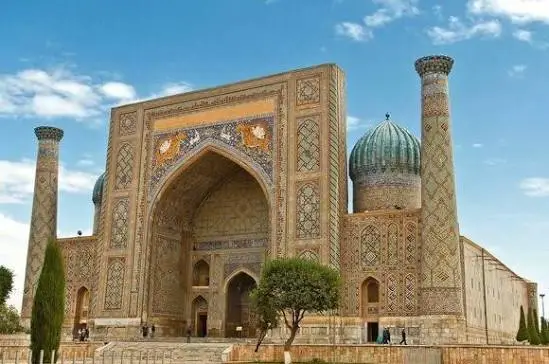
What you see today is the result of two building campaigns two centuries apart. In the early 15th century Timur’s grandson Ulugbek, governor of Samarkand, built a madrasah on the west side, a khanaka (Sufi lodge) opposite and a caravanserai. In the 17th century, when Samarkand was ruled from Bukhara, the governor Yalangtush Bahadur replaced the decayed khanaka with the Sher-Dor madrasah, deliberately mirroring Ulugbek’s facade, and then built the Tilya-Kori madrasah on the north side. The three facades form one of the most famous ensembles of Islamic architecture.
The three madrasahs
Ulugbek madrasah (1417–1420), on the left as you face the square from the viewing platform, is the oldest. Its portal is decorated with geometric star patterns that reflect Ulugbek’s interest in mathematics and astronomy, and it was one of the leading universities of the Islamic world, where astronomy and mathematics were taught alongside religion.
Sher-Dor madrasah (1619–1636), on the right, copies the proportions of Ulugbek’s building. Its portal shows two tiger-like lions chasing deer, with human-faced suns rising behind them, a rare and bold use of living creatures on a religious building. The image has become a national symbol.
Tilya-Kori madrasah (1646–1660), in the centre, served both as a college and as the city’s Friday mosque. Its name means “gilded”: inside, the mosque’s dome and walls are covered in gold-leaf ornament in the kundal technique, restored in the 20th century.
Inside the madrasahs
The courtyards of all three madrasahs are open to visitors. The former student cells (hujras) are now craft and souvenir shops selling suzani, ceramics, miniatures, silk and carpets. Inside the Tilya-Kori, beyond the gilded mosque, there is a small exhibition of photographs of Samarkand before and during restoration, which shows how much of the ensemble was rebuilt in Soviet times, including the straightening of a leaning minaret of the Ulugbek madrasah in the 1930s.
Tickets, hours and the light show
A single ticket covers the square and the three madrasahs. Hours are roughly from early morning to early evening, longer in summer; prices and hours change, so check at the ticket office on the south side. You can view and photograph the facades from the public platform without a ticket.
In the evening the facades are lit, and on many evenings a sound-and-light show is projected onto them, especially in the tourist season. Times vary; ask your hotel or guide on the day. The square is also used for concerts and festivals, including the Sharq Taronalari international music festival, when access can be limited.
When to visit and photo tips
The three facades face east (Ulugbek), west (Sher-Dor) and south (Tilya-Kori), so the light moves around the square through the day: morning sun on the Ulugbek madrasah, midday on Tilya-Kori and late-afternoon sun on Sher-Dor. The hour after sunset, when the lights come on and the sky is still blue, is the classic photograph. Early morning is the quietest time and the best for exploring the courtyards without crowds.
Dress for a public square rather than a mosque, but cover shoulders if you go into the Tilya-Kori mosque. Allow time to sit on the steps of the platform: the Registan is also where Samarkand families come in the evening, and watching the square is part of the experience.
The Registan through the centuries
Under Timur the Registan was not yet a monumental square but a busy crossroads with a domed market, where six streets met. Ulugbek’s buildings in the early 15th century gave it a formal shape for the first time. After the Timurids, power moved to Bukhara and Samarkand declined; by the early 18th century the city was almost deserted after wars and famine, and for a time the madrasahs stood empty.
The Russian conquest of 1868 brought the first photographs, which show cracked portals, missing domes and minarets leaning at alarming angles. Restoration began in the 1920s and continued for most of the 20th century, with engineers stabilising foundations and craftsmen relearning tile-making techniques to replace lost mosaics. Today’s ensemble is the result of that long effort, and it is the reason the Registan looks complete rather than ruined. Knowing this does not make it less impressive: it is a living monument, cared for by generations of restorers.
Frequently asked questions
How much time do you need at the Registan?
Two to three hours to see all three madrasahs and their courtyards, plus a return visit after dark for the illuminated facades.
Is the Registan free to visit?
The square can be seen from the public platform for free. Entering the square and the madrasahs requires a ticket, sold at the office on the south side.
Which madrasah is the oldest?
The Ulugbek madrasah on the west side, built in 1417–1420. Sher-Dor and Tilya-Kori date from the 17th century.
Is there a light show at the Registan?
On many evenings in the tourist season a sound-and-light show is projected onto the facades. Times change, so ask locally on the day.
Rules, timetables and prices change. We check this page regularly, but always confirm entry requirements with official sources before you travel.