Bukhara · Sights
Poi Kalyan: the great ensemble of Bukhara
The Poi Kalyan ensemble in Bukhara, with the Kalyan minaret, the Kalyan mosque and the Mir-i-Arab madrasah, their history, what to see and the best light.
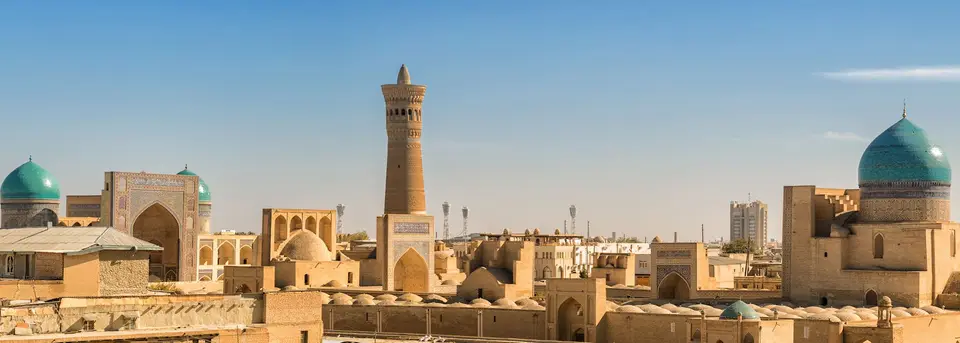
Poi Kalyan (“at the foot of the Great One”) is the religious heart of Bukhara: a square framed by the 12th-century Kalyan minaret, the Kalyan mosque (1514), one of the largest in Central Asia, and the Mir-i-Arab madrasah (1530s), still a working religious school. Allow about an hour; come in the early morning and again at dusk, when the minaret and domes are lit.
The ensemble
The name refers to the minaret, kalon meaning “great” in Tajik, the language spoken by many Bukharans. Everything here is arranged around it. The minaret survived the destruction of the city by Genghis Khan’s army in 1220, when the earlier mosque burned; the mosque and the madrasah that face each other across the square today were built in the 16th century, when Bukhara became the capital of the Shaybanid dynasty and was filled with new monuments.
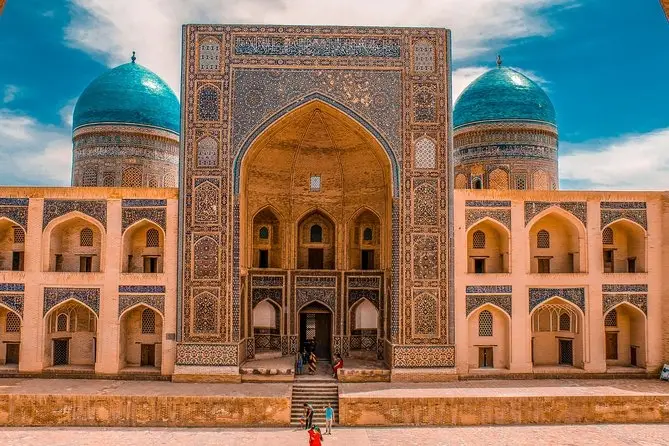
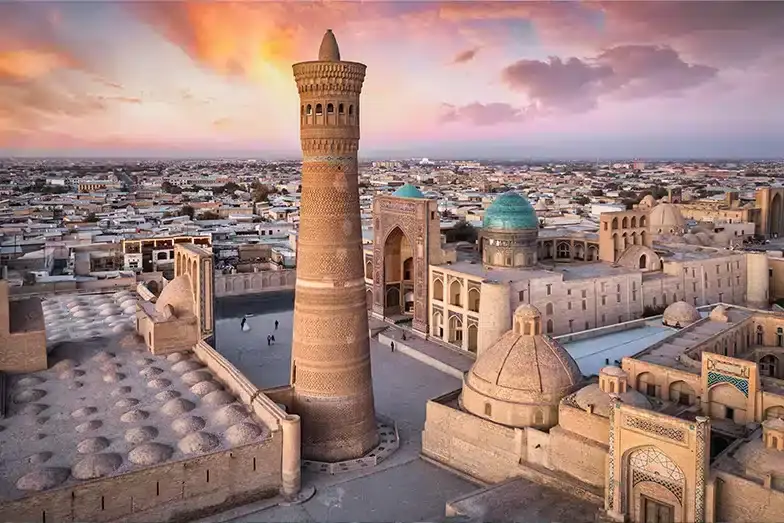
Standing in the square, you have the mosque on the west, the madrasah on the east and the minaret at the north-west corner, linked to the mosque by a bridge at roof level. The two great portals face each other in a composition known as kosh, “pair”, typical of Bukhara.
The Kalyan minaret
Built in 1127 by the Karakhanid ruler Arslan Khan, the Kalyan minaret is around 46 metres high and tapers from a broad base to a lantern of sixteen arches. Its surface is covered in bands of patterned brickwork, each different, with one of the earliest uses of blue glazed tiles in the region. It served to call to prayer, as a watchtower and as a landmark for caravans crossing the desert.
The Kalyan mosque
The Kalyan mosque, completed in 1514, stands on the site of the 12th-century Friday mosque. Its courtyard, about 130 by 80 metres, is surrounded by galleries roofed with nearly three hundred small domes on brick pillars, and could hold some ten thousand worshippers. At the far end the main portal leads to the prayer hall under a great turquoise dome. In the middle of the courtyard grows a single tree beside a small octagonal pavilion.
The mosque was used as a warehouse in the Soviet period and returned to worship in the 1990s. It is open to visitors outside prayer times, especially Friday midday, when the courtyard fills with worshippers. Walk the galleries for the endless perspectives of arches, a favourite with photographers.
The Mir-i-Arab madrasah
Opposite the mosque, the Mir-i-Arab madrasah was built in 1535–1536 with funds associated with Sheikh Abdullah Yamani, known as Mir-i-Arab, a spiritual adviser to the Shaybanid khan Ubaydullah. Its two turquoise domes are among the most photographed in Bukhara. It is one of the few madrasahs in Central Asia that functioned as a religious school during much of the Soviet era, and it still teaches students today, so visitors can usually see only the entrance hall and look through the grille into the courtyard.
When to visit and photograph
Morning: the low sun lights the facade of the madrasah and the eastern side of the minaret. Early morning is quiet, with students arriving and pigeons over the square.
Late afternoon: the light falls on the mosque portal and the western face of the minaret, turning the brick golden.
Evening: the ensemble is illuminated after dark, and the square becomes one of the most atmospheric places in Central Asia. Cafés with roof terraces on the edge of the square, and the trading dome of Toki Zargaron, give good viewpoints.
Tickets: the square is free. A ticket is needed for the Kalyan mosque courtyard; the minaret itself is not normally open for climbing. Dress modestly in the mosque: shoulders and knees covered, a headscarf for women in the prayer hall.
How to combine it
Poi Kalyan is in the middle of the old city. It is a short walk from the Ark to the west, and a few minutes from the domed bazaar of Toki Zargaron and the paired madrasahs of Ulugbek and Abdulaziz Khan to the east. From there the lane of the trading domes continues to Lyabi-Hauz. Most first-time visitors walk this route in a morning and return to Poi Kalyan in the evening for the illuminations.
Frequently asked questions
What does Poi Kalyan mean?
“At the foot of the Great One”, referring to the Kalyan minaret that dominates the square.
Can you go inside the Mir-i-Arab madrasah?
Usually only into the entrance hall. It is a working religious school, so the courtyard and cells are closed to visitors.
Can you climb the Kalyan minaret?
Not normally. The minaret is closed to the public; the best views of it are from the square and nearby roof terraces.
Rules, timetables and prices change. We check this page regularly, but always confirm entry requirements with official sources before you travel.