Bukhara · Sights
The Kalyan Minaret of Bukhara
The Kalyan minaret, built in 1127 and the symbol of Bukhara, its brickwork, its legends, its role for caravans and the best places to see and photograph it.
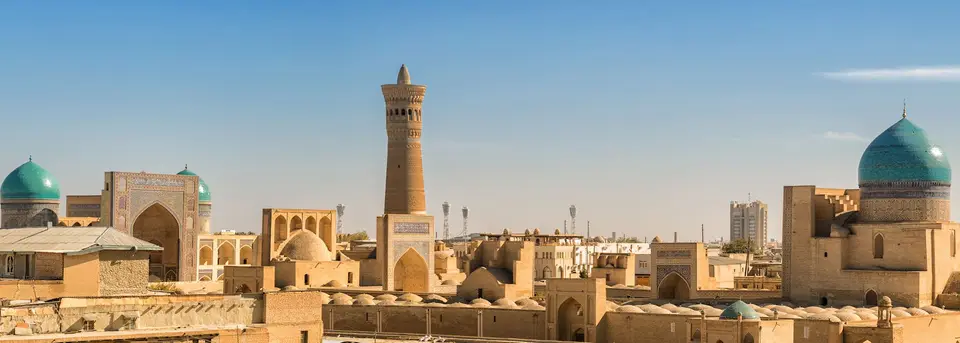
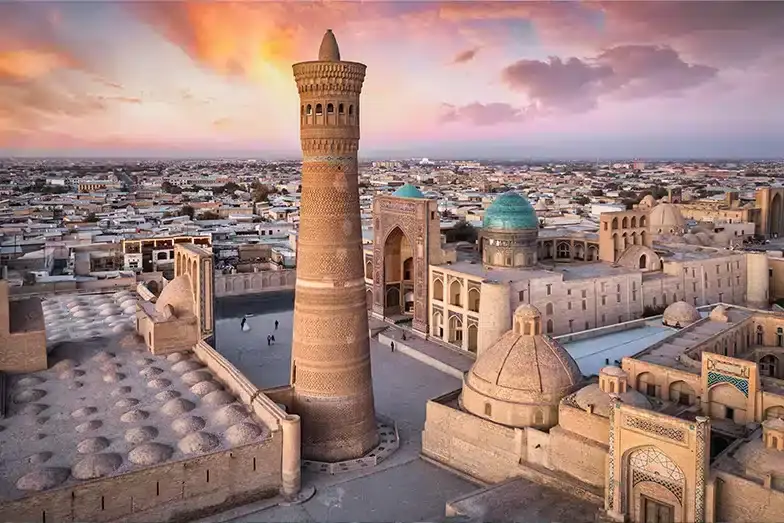
The Kalyan minaret is the symbol of Bukhara: a tapering brick tower about 46 metres high, built in 1127 by the Karakhanid ruler Arslan Khan. It survived the Mongol conquest of 1220, when most of the city was destroyed. It stands in the Poi Kalyan square and is not open for climbing, but it is visible from all over the old city and is illuminated at night.
History
In the early 12th century Bukhara was ruled by the Karakhanids, a Turkic dynasty that had replaced the Samanids. Arslan Khan rebuilt the city’s Friday mosque and added a new minaret beside it. According to a medieval account, an earlier tower collapsed onto the mosque during construction, so the builders made the new one exceptionally solid. Its foundations reach some 10 metres deep, laid, it is said, with a mortar mixed with camel milk and egg yolks that took two years to set.
The tower was called Minorai Kalon, the “Great Minaret”. For centuries it was the tallest structure in Central Asia, and on a clear day it could be seen from far out in the desert, so it acted as a lighthouse for caravans approaching the oasis. Fires were reportedly lit in the lantern at night.
The Genghis Khan legend
When the Mongol army took Bukhara in 1220, the city was looted and burned, and the Friday mosque beside the minaret was destroyed. The minaret survived. A popular story says that Genghis Khan, looking up at the tower, lost his hat; when he bent down to pick it up, he said that a tower that had made him bow deserved to be spared. Historians prefer a simpler explanation: there was no reason to waste effort bringing down a solid tower that was useful as a watchtower.
Another legend gave the minaret the name “Tower of Death”, claiming that criminals were thrown from the top. Executions of this kind may have happened in the 18th and 19th centuries, though the stories were probably exaggerated by European travellers.
How it is built
The minaret is a round tower of baked brick, about 9 metres across at the base and narrowing towards the top. A spiral staircase of more than a hundred steps winds around a central pillar to the lantern, a rotunda of sixteen arches decorated with a frieze of stalactite-like muqarnas.
What makes it remarkable is the decoration. The surface is divided into bands, each with a different pattern made by laying bricks at angles, vertically or in relief: chevrons, diamonds, zigzags and interlacing. Between the bands run inscriptions in Kufic script. Near the top is one of the earliest uses of turquoise glazed tiles in Central Asian architecture, a hint of the colour that would cover Timurid and Shaybanid buildings a few centuries later. The effect changes with the light: in the morning the brick is pale, at sunset it turns gold and pink, and at night the illuminated patterns stand out against a dark sky.
The best viewpoints
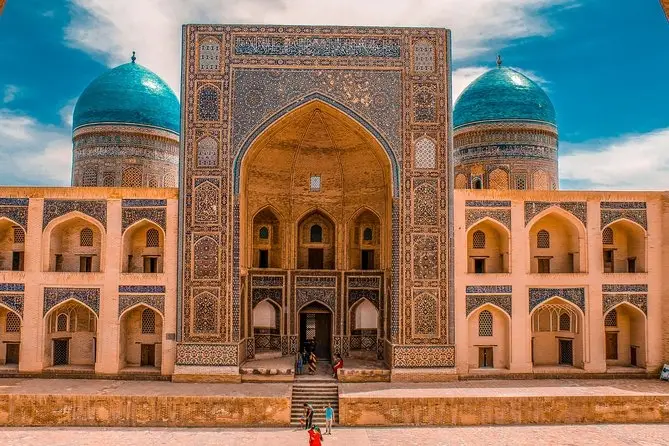
- Poi Kalyan square, between the mosque and the madrasah, for the full height of the tower and the classic view with the Mir-i-Arab domes.
- Inside the Kalyan mosque courtyard, where the minaret rises above the walls and galleries.
- Roof terraces of cafés around the square, especially at sunset.
- The walls of the Ark, from where the minaret rises above the old city.
- The lane by the Toki Zargaron dome, looking back west, where the tower appears framed between old buildings.
The minaret is closed to climbing. Occasionally limited access has been permitted in the past, but do not plan on it.
Visiting
Seeing the minaret costs nothing; it stands in an open square in the Poi Kalyan ensemble, a few minutes from the trading domes. Come early in the morning for quiet and soft light, and return after dark for the illuminations. A visit to the Kalyan mosque courtyard, which needs a ticket, adds the best close-up view of the tower’s base and the bridge that once linked it to the mosque roof.
Frequently asked questions
How tall is the Kalyan minaret?
About 46 metres, with foundations around 10 metres deep. For centuries it was the tallest building in Central Asia.
Why did Genghis Khan spare the Kalyan minaret?
Legend says the tower made him bow when he stooped to pick up his hat; more likely it was simply useful as a watchtower.
Can you climb the Kalyan minaret?
No. It is closed to visitors, but it can be seen from the square, the mosque courtyard and nearby terraces.
Rules, timetables and prices change. We check this page regularly, but always confirm entry requirements with official sources before you travel.