Bukhara · Sights
Mir-i-Arab Madrasah, Bukhara
The Mir-i-Arab madrasah on Poi Kalyan square, its twin blue domes, its founder, its unusual history as a working school through the Soviet era, and what visitors can see.
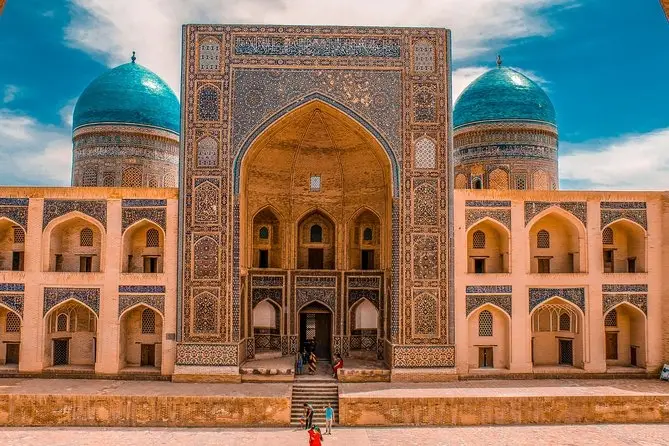
The Mir-i-Arab madrasah faces the Kalyan mosque across Poi Kalyan square. Built in 1535–1536, it is famous for its two turquoise domes and for being one of the few Islamic schools in Central Asia that operated during much of the Soviet period. It is still a working madrasah, so visitors can usually enter only the vestibule and look into the courtyard; the best views are from the square.
Who was Mir-i-Arab?
Mir-i-Arab (“Prince of the Arabs”) was the name given to Sheikh Abdullah Yamani, a religious scholar said to have come from Yemen, who became the spiritual guide of the Shaybanid ruler Ubaydullah Khan. Ubaydullah, a nephew of Muhammad Shaybani, made Bukhara his capital and was a great patron of building and learning.
Tradition says the madrasah was paid for with the ransom of thousands of Persian prisoners taken in Ubaydullah’s wars against Safavid Iran. Whatever the source of the funds, the building became one of the most prestigious schools of Islamic law and theology in the region. Both the sheikh and the khan are buried in a room under the northern dome, an unusual case of a ruler being laid to rest beside his teacher.
The architecture
The madrasah follows the classic Central Asian plan: a rectangular two-storey building around an inner courtyard, with student cells (hujra) on both floors, four large halls (aivan) in the middle of each side, and a monumental portal facing the square.
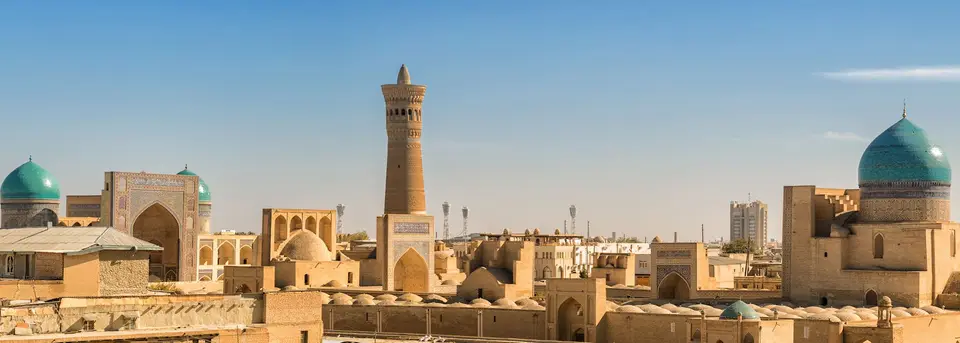
Its distinctive features are the two great domes on tall drums that flank the entrance, one over the mausoleum and one over the mosque. They are covered in bright turquoise tiles and, with the Kalyan minaret, form one of the most recognisable skylines in Central Asia. The portal is decorated with geometric mosaic in blue, white and yellow, and its arch is filled with stalactite vaulting. The corner towers (guldasta) are slim and elegant.
The portal aligns precisely with that of the Kalyan mosque across the square, creating the face-to-face kosh arrangement characteristic of Bukhara.
A school through the Soviet era
After the Bolshevik takeover in 1920, religious schools across Central Asia were closed one by one, and by the late 1920s almost none remained. Mir-i-Arab was closed too, but in the mid-1940s, when Soviet policy towards religion relaxed during and after the Second World War, it was allowed to reopen. For decades it was one of only a handful of officially permitted madrasahs in the whole Soviet Union, training imams for the Muslim communities of Central Asia and beyond.
This continuity is unusual: most madrasahs that visitors see in Uzbekistan today are former schools now used as museums, craft shops or hotels. At Mir-i-Arab you may see students in the square or hear lessons through the gate. Since independence in 1991 the madrasah has continued as one of the main institutions of Islamic education in Uzbekistan, and many of the country’s imams studied here.
Visiting
Access: the main hall at the entrance is open to visitors; the courtyard and cells are reserved for students. Please respect the boundary marked by the grille.
Dress and behaviour: dress modestly, keep your voice low, and ask before photographing students or teachers. Avoid visits during prayer times, especially on Friday.
Best photos: in the morning the sun is on the facade. From the Kalyan mosque portal opposite, you can frame the domes and the portal head-on; from the north-east corner of the square, the domes line up with the minaret. In the evening the whole ensemble is lit.
Ticket: none needed to view the exterior or the vestibule.
Nearby
The madrasah is part of the Poi Kalyan ensemble. Behind it, a short walk east, lies the domed bazaar of Toki Zargaron and the paired Ulugbek and Abdulaziz Khan madrasahs. The Ark is ten minutes’ walk to the north-west.
Frequently asked questions
Can tourists go inside the Mir-i-Arab madrasah?
Only into the entrance hall. It is a working Islamic school, so the courtyard and student cells are closed to visitors.
Who is buried in the Mir-i-Arab madrasah?
Sheikh Abdullah Yamani, known as Mir-i-Arab, and the Shaybanid ruler Ubaydullah Khan, in a chamber under the northern dome.
When was the Mir-i-Arab madrasah built?
In 1535–1536, under the Shaybanid ruler Ubaydullah Khan.
Rules, timetables and prices change. We check this page regularly, but always confirm entry requirements with official sources before you travel.