Bukhara · Sights
The Ark of Bukhara: citadel of the emirs
The Ark of Bukhara, the fortified royal town where emirs ruled until 1920, what is inside, how long to allow and how it fits a walk through the old city.
The Ark is the citadel of Bukhara, a walled town on an artificial mound that was the seat of the city’s rulers for well over a thousand years, until the last emir fled in 1920. Inside are the coronation courtyard, the Friday mosque, the emir’s quarters and several small museums. Allow 1–1.5 hours, ideally in the morning or late afternoon, and combine it with the Bolo-Hauz mosque opposite.
A city within the city
Archaeologists believe the mound of the Ark has been occupied since at least the middle of the first millennium BC. Each conqueror and dynasty, from the Sogdian princes to the Samanids, the Karakhanids, the Shaybanids and the Manghit emirs, rebuilt the fortress on the ruins of the last, so that the hill grew higher with every layer of collapsed brick. The massive sloping walls you see today, rising some 16–20 metres above the square, date mostly from the 18th century.
The Ark was not a single palace but a small town of its own. At its height it held the residence of the ruler and his harem, the treasury, the mint, the arsenal, stables, offices of state, mosques, prisons and the houses of officials and servants, perhaps three thousand people in all. The legend of its founding tells of the hero Siyavush, who was promised as much land as could be covered by an ox hide, cut the hide into thin strips and enclosed the whole hill.
The end of the emirate
In September 1920 the Red Army under Mikhail Frunze stormed Bukhara. Aircraft and artillery bombarded the city, and a large part of the Ark was destroyed by fire. The last emir, Alim Khan, escaped to Afghanistan, and the Bukharan People’s Soviet Republic was declared. Today large areas inside the walls are open ground where buildings once stood, which gives the visit a slightly melancholy feeling.
In front of the gate lies the Registan of Bukhara, the old parade ground and market square, where public announcements and executions took place. Here in 1842 two British officers, Charles Stoddart and Arthur Conolly, were beheaded on the orders of Emir Nasrullah, an episode of the “Great Game” between Britain and Russia. They had been held in the infamous bug pit of the Zindan prison nearby.
What to see inside
You enter through the monumental western gate, flanked by two towers and topped by a gallery and a 19th-century clock, then climb a long covered ramp lined with former cells and storerooms.
- The Friday mosque (Juma mosque), built in the early 20th century, with a carved wooden porch (aivan) on slender columns and a painted ceiling. Inside is a small exhibition of manuscripts and calligraphy.
- The coronation courtyard (Kurinish-khana), where the emirs received ambassadors and were crowned. The marble throne stands under a canopy facing a large open court; visitors bowed as they approached and were expected to walk out backwards.
- The emir’s reception rooms and offices, several now housing museum displays: archaeology of the Bukhara oasis, coins and the history of the emirate, everyday objects, costumes and photographs from the late 19th and early 20th century.
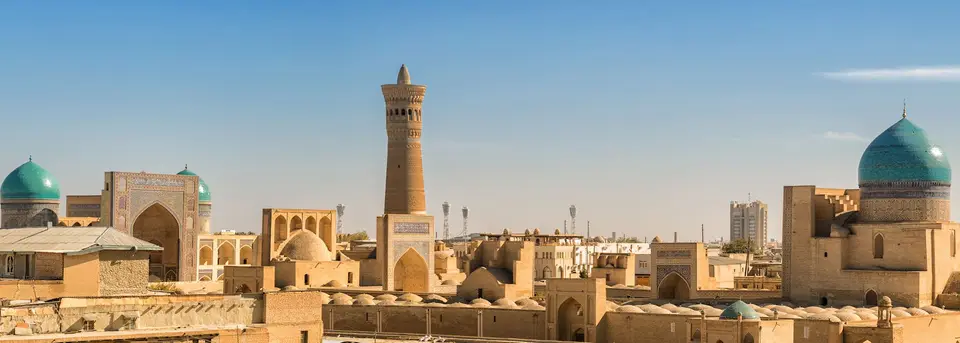
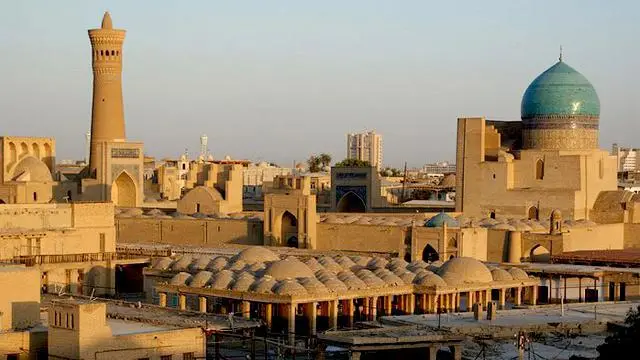
- The ramparts. From the parts of the walls open to visitors there are fine views over the domes and minarets of the old city, with the Kalyan minaret to the south-east.
Labelling is in English in many rooms, but it is uneven; a guide brings the stories of the emirs, their court and their prisoners to life.
Practical information
Location: on the north-western edge of the old city, about 10 minutes’ walk from Poi Kalyan and 15–20 minutes from Lyabi-Hauz.
Tickets: bought at the gate. The main ticket covers the courtyard and most museums; some exhibitions may be extra, and there is usually a fee for photography inside museum rooms. Check the current price on arrival.
Opening hours: daily, generally from morning until early evening, with shorter hours in winter. Times can change, so confirm locally.
Time needed: 1–1.5 hours for the courtyard, mosque, museums and walls.
When to go: in summer, in the first hours of opening or late afternoon; there is little shade inside the walls. The west-facing gate and walls glow in the late afternoon sun, the best time for photographs from the square.
Nearby
Across the square stands the Bolo-Hauz mosque, with its high porch of twenty carved wooden columns reflected in a pool. Behind the Ark is the Zindan, the emir’s prison, now a small museum. To the west lies the green expanse of Samanid Park with the 10th-century Samanid mausoleum and the Chashma-Ayub shrine, and to the south-east the Poi Kalyan ensemble with the Kalyan minaret. A good morning walk runs from the Ark to Poi Kalyan and on through the trading domes to Lyabi-Hauz for lunch.
Frequently asked questions
How long do you need at the Ark of Bukhara?
About 1–1.5 hours to see the courtyards, the Friday mosque, the museums and the views from the walls.
Who lived in the Ark?
The rulers of Bukhara, most recently the Manghit emirs, with their families, officials, guards and servants, until the Red Army took the city in 1920.
Is the Ark worth visiting?
Yes. Much of it was destroyed in 1920, but the gate, the ramp, the coronation courtyard and the views make it one of Bukhara’s key sights.
Rules, timetables and prices change. We check this page regularly, but always confirm entry requirements with official sources before you travel.