Tashkent · Sights
Khast Imam (Hazrati Imam) complex, Tashkent
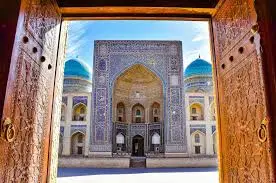
The Khast Imam complex, Tashkent’s religious heart, with the Uthman Quran, the Barak Khan madrasah, the Kaffal Shashi mausoleum and the Hazrati Imam mosque.
The Khast Imam (Hazrati Imam) complex in Tashkent’s old town is the religious centre of Uzbekistan. It holds the Uthman Quran, one of the oldest surviving Qurans in the world, in the Muyi Muborak library, along with the 16th-century Barak Khan madrasah, the Kaffal Shashi mausoleum and the large modern Hazrati Imam mosque. Allow 1–1.5 hours.
The saint of Tashkent
The complex is named after Abu Bakr Kaffal Shashi (903–976), known as Hazrati Imam, “the holy imam”. Born in Shash, the old name of Tashkent, he was a scholar of Islamic law and the Quran, a poet and, according to tradition, a skilled locksmith (kaffal). He travelled widely in the Islamic world and is regarded as the first imam of Tashkent and one of the founders of the city’s religious tradition. His tomb has been a place of pilgrimage for a thousand years.
Over the centuries, mosques, madrasahs and mausoleums grew up around his grave. The square was extensively restored and partly rebuilt in 2007, when Tashkent was named a capital of Islamic culture, and it is now the seat of the Muslim Board of Uzbekistan.
The Uthman Quran
The most precious object in the complex is the Uthman Quran (also called the Samarkand Kufic Quran), kept in the Muyi Muborak library. It is a large manuscript on parchment written in early Kufic script and is traditionally believed to be one of the copies made under the third caliph, Uthman (ruled 644–656). According to tradition, Uthman was reading it when he was murdered, and dark stains on some pages are said to be his blood.
Scholars date the manuscript to the 8th–9th centuries or earlier; whatever its exact date, it is one of the oldest Qurans in existence. Tradition holds that Timur brought it to Samarkand. In 1869 it was taken to St Petersburg by the Russian authorities, then returned to Central Asia after the revolution, and it has been kept in Tashkent since the 20th century. Only part of the manuscript survives; some pages are held elsewhere.
The library also displays other rare manuscripts and Qurans in many languages. Photography is not allowed in the room with the Uthman Quran, and visitors should dress modestly.
The buildings
- Barak Khan madrasah. Built in the 16th century under the Shaybanid rulers of Tashkent, with a tall portal decorated with blue tiles and mosaic. Its cells now house craft shops selling ceramics, woodcarving, miniatures and textiles.
- Kaffal Shashi mausoleum. The tomb of the saint, built in 1541–1542 over his grave, with a domed chamber and a tiled portal. It stands slightly apart, behind the square.
- Tillya Sheikh mosque. A 19th-century mosque with a carved wooden porch, once home to the Uthman Quran.
- Hazrati Imam mosque. The large Friday mosque built in 2007, with two minarets about 50 metres high, carved sandalwood columns from India and a vast prayer hall. Non-Muslims can usually see it from the outside; access inside depends on prayer times.
- The Islamic Institute of Imam al-Bukhari, a working religious school in a restored madrasah.
Visiting
Location: in the old town of Tashkent, about 2 km north of Chorsu bazaar.
Getting there: by taxi, or about 15–20 minutes’ walk from Chorsu or Gafur Gulom metro station through the old town.
Tickets: the square is free; a small fee is charged for the Muyi Muborak library.
Time needed: 1–1.5 hours.
Etiquette: dress modestly, with shoulders and knees covered; women should bring a scarf. Avoid Friday midday prayers. No photography of the Uthman Quran.
Combine with: Chorsu bazaar and the Kukeldash madrasah for a half day in the old town, and the white marble Minor mosque on the canal.
Frequently asked questions
What is the Uthman Quran?
One of the oldest surviving Qurans, traditionally linked to the caliph Uthman. It is kept in the Muyi Muborak library in the Khast Imam complex.
Can non-Muslims visit the Khast Imam complex?
Yes. Visitors are welcome if they dress modestly; the square, madrasah and library are open to all.
How long do you need at Khast Imam?
About 1–1.5 hours to see the library, the madrasah, the mausoleum and the square.
Rules, timetables and prices change. We check this page regularly, but always confirm entry requirements with official sources before you travel.