Bukhara · Sights
Lyabi-Hauz: Bukhara’s pool square
Lyabi-Hauz, the shaded pool square of Bukhara with its 17th-century madrasah and khanaka, old mulberry trees, the Nasreddin statue, teahouses and evening life.
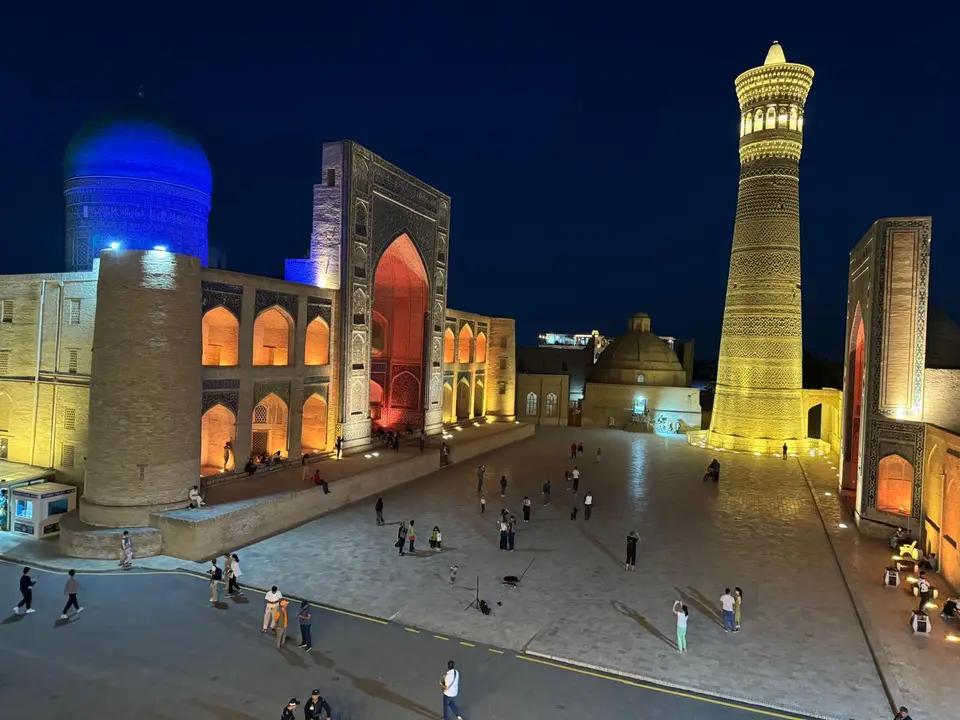
Lyabi-Hauz (“by the pool”) is the most beloved square in Bukhara: a stone-lined pool built in 1620, shaded by old mulberry trees and surrounded by three monuments, the Kukeldash madrasah, the Nadir Divan-Begi khanaka and the Nadir Divan-Begi madrasah. It is the natural meeting point of the old city, busiest in the evening, when the teahouses fill and the buildings are lit.
The pools of Bukhara
Bukhara stands in a dry oasis fed by canals from the Zarafshan river. Until the early 20th century the city’s water came from a network of canals and more than a hundred stone-lined pools (hauz), where people drew water for drinking, washing and cooking. The pools gave the city coolness and life, but the standing water also spread disease, and in the Soviet period nearly all of them were drained and filled in. Lyabi-Hauz is one of the very few that survive, and the only one that still forms the centre of a public square.
History of the ensemble
The ensemble was created by Nadir Divan-Begi, vizier and uncle of the Ashtarkhanid ruler Imam Quli Khan, in the early 17th century. He built the pool in 1620, the khanaka on its western side at the same time, and the madrasah on its eastern side in 1622. The older Kukeldash madrasah, from the 1560s, already stood to the north.
A well-known legend explains how the vizier got the land. Part of the site belonged to a Jewish widow who refused to sell. Nadir Divan-Begi had a canal dug under her house so that it began to collapse, and she agreed to give up the plot in exchange for land elsewhere, where, according to the story, the community built a synagogue. Another tale says the pool took so long to fill that people called it the “pool of the poor”. Such stories cannot be verified, but they are part of the square’s charm.
Around the pool, stone steps lead down to the water. The mulberry trees on its banks are among the oldest in the city; one is said to have been planted in the late 15th century.
The buildings around the pool
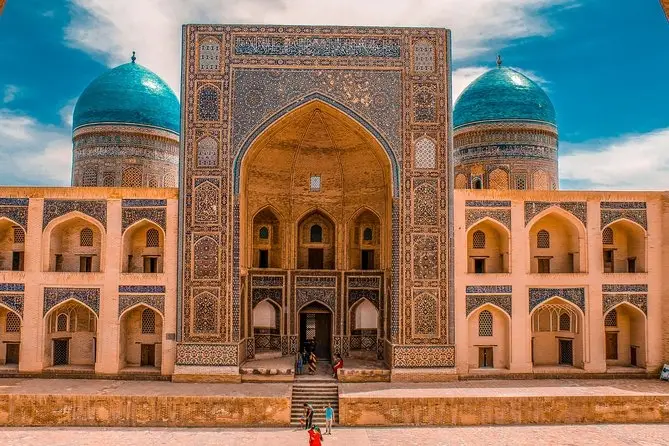
Nadir Divan-Begi madrasah (east side). Built originally as a caravanserai and converted to a madrasah, it is famous for the mosaic on its portal: two great birds (simurgh) carrying white deer in their claws towards a sun with a human face. Images of living beings are rare in Islamic architecture, which makes this portal one of the most photographed in Uzbekistan. See Nadir Divan-Begi madrasah.
Nadir Divan-Begi khanaka (west side). A lodge for Sufi dervishes, with a tall portal facing the pool and a domed central hall. It houses exhibitions, and its interior is cool and quiet.
Kukeldash madrasah (north side). One of the largest madrasahs in Central Asia, built in 1568–1569 by a high official of the Shaybanid court. See Kukeldash madrasah.
Nasreddin Hodja. Beside the khanaka sits a bronze statue of Nasreddin Hodja, the wise fool of Middle Eastern and Central Asian folklore, on his donkey, one hand on his heart and the other raised in greeting. Children climb on the donkey, and people rub its ears for luck.
Life on the square
Lyabi-Hauz is where Bukhara relaxes. In the daytime it is a shady rest stop between sights; in the evening locals and visitors sit at teahouse tables around the pool, eating shashlik and drinking green tea while the facades are illuminated. In spring and autumn you may see wedding couples posing for photographs, and folk musicians sometimes play in the madrasah courtyards.
Restaurants and cafés with tables by the water are convenient but can be busy and more expensive than places a few streets away. Mosquitoes can be a nuisance on summer evenings; bring repellent.
Practical information
Location: in the south-east of the old city. Many guesthouses are within a few minutes’ walk.
Tickets: the square is free. The madrasahs and khanaka have small entrance fees or are free, depending on what is inside; many hold craft shops.
When to go: early morning for empty, calm reflections and photographs; evening for atmosphere.
Nearby: the Magoki-Attori mosque and the first of the trading domes, Toki Sarrafon, are a few minutes west; the Jewish quarter lies just to the south. From Lyabi-Hauz, the walk through the domes to Poi Kalyan takes about 10 minutes.
Frequently asked questions
What does Lyabi-Hauz mean?
“By the pool” or “around the pool”, from the Tajik lab (lip, edge) and hauz (pool).
When was Lyabi-Hauz built?
The pool and the khanaka in 1620, the Nadir Divan-Begi madrasah in 1622; the Kukeldash madrasah is older, from 1568–1569.
Is Lyabi-Hauz worth visiting at night?
Yes. In the evening the buildings are lit and the teahouses around the pool are full, making it the liveliest place in old Bukhara.
Rules, timetables and prices change. We check this page regularly, but always confirm entry requirements with official sources before you travel.