Bukhara · Sights
Nadir Divan-Begi Madrasah and Khanaka, Bukhara
The Nadir Divan-Begi madrasah at Lyabi-Hauz, its famous portal with birds, deer and a human-faced sun, the khanaka opposite, their history and the evening folk shows.
The Nadir Divan-Begi madrasah (1622) stands on the east side of Lyabi-Hauz. It is famous for the mosaic over its portal: two simurgh birds carrying white deer towards a sun with a human face, a rare image of living beings in Islamic architecture. Its courtyard holds craft shops and, in the season, evening folk shows. The vizier’s khanaka faces it across the pool.
The vizier and his buildings
Nadir Divan-Begi was the vizier (divan-begi, head of the chancellery) and uncle of Imam Quli Khan, who ruled Bukhara in the early 17th century under the Ashtarkhanid dynasty. He used his wealth to remodel the quarter around a new pool, creating the Lyabi-Hauz ensemble: the pool and the khanaka in 1620, and this building in 1622.
It was built as a caravanserai, an inn for merchants, and that explains its unusual plan: it has no domed lecture halls (darskhana) or mosque at the corners, and no inner portals in the courtyard, as a true madrasah would. According to a popular story, the ruler attended the opening, praised the “beautiful madrasah”, and since no one dared to correct him, the building was converted into one.
The famous portal
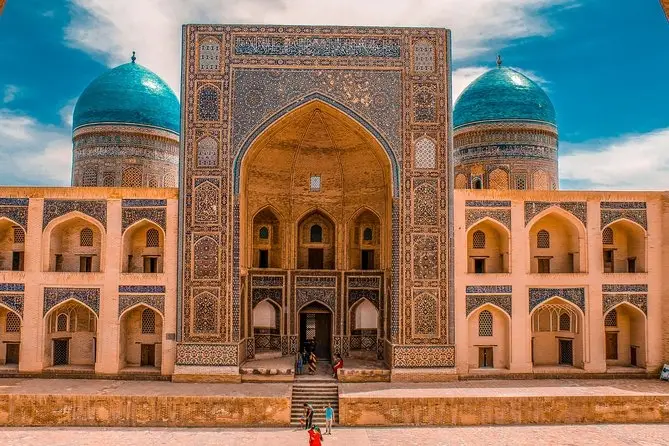
The facade is decorated in glazed tile mosaic, with geometric patterns and plant scrolls in blue, white, yellow and green. Above the entrance arch is the scene that made it famous. Two great birds with spread wings fly towards the centre, each carrying a white deer in its claws. Between them a sun rises, drawn with a human face framed by rays.
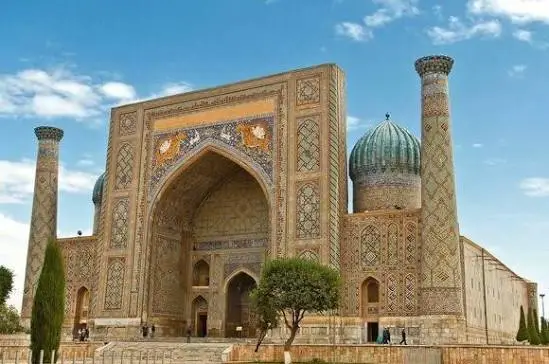
The birds are usually identified as the simurgh, the mythical bird of Persian legend, or as phoenixes. The sun with a face recalls very old Iranian and Central Asian traditions, perhaps even pre-Islamic sun worship. Islamic tradition generally avoided images of living beings on religious buildings, so such a scene on the front of a madrasah is remarkable. A similar theme appears on the Sher-Dor madrasah in Samarkand, built at about the same time, where tigers chase deer under human-faced suns.
Today the simurgh of this portal is one of the best-known images of Bukhara, reproduced on souvenirs, ceramics and countless photographs. The tilework is best in soft morning light; in the evening the portal is illuminated.
Inside the madrasah
The courtyard is surrounded by two levels of former student cells, now mostly craft shops and workshops: ceramics, textiles, miniatures, jewellery and puppets. In the main season the courtyard hosts evening folk performances with dinner, music, dancing and a fashion show of traditional and modern costumes. These are aimed at visitors but well done and a pleasant introduction to Bukharan music. Check the schedule locally.
The khanaka opposite
On the west side of the pool stands the Nadir Divan-Begi khanaka, built in 1620 as a lodge for Sufi dervishes. A khanaka was a place where Sufis lived, prayed and performed their ceremonies, and where travellers could find shelter. The building has a tall portal facing the pool, and inside a high domed hall surrounded by small rooms on two floors. It houses small exhibitions, and its cool interior is a welcome retreat on a hot day. In front of it sits the statue of Nasreddin Hodja on his donkey.
Practical information
Location: east side of Lyabi-Hauz, in the south-east of the old city.
Tickets: the courtyard is generally free to enter during the day, as it is used by shops. Evening shows are ticketed and often include dinner.
Time needed: 20–30 minutes; longer if you shop or stay for a show.
Combine with: the Kukeldash madrasah on the north side of the pool, the Magoki-Attori mosque and the trading domes a few minutes to the west, and the Jewish quarter just to the south.
Frequently asked questions
What is shown on the Nadir Divan-Begi madrasah portal?
Two simurgh birds carrying white deer towards a sun with a human face, set in colourful tile mosaic.
Was it built as a madrasah?
No. It was built in 1622 as a caravanserai and converted into a madrasah, which explains its unusual plan.
Are there shows at the Nadir Divan-Begi madrasah?
In the tourist season there are evening folk performances with music, dancing and costumes, usually with dinner. Check locally for days and times.
Rules, timetables and prices change. We check this page regularly, but always confirm entry requirements with official sources before you travel.