Bukhara · Sights
Magoki-Attori Mosque, Bukhara
The Magoki-Attori mosque, sunk below street level with a 12th-century carved facade, its layers of history from temples to the carpet museum, and how to visit.
The Magoki-Attori mosque is one of the oldest surviving buildings in Bukhara. Its southern facade, of finely carved brick and terracotta, dates from the 12th century, and the mosque stands several metres below the modern street, which shows how much the city has risen over the centuries. Excavations found traces of earlier temples beneath it. Today it houses a small carpet museum.
The mosque in the pit
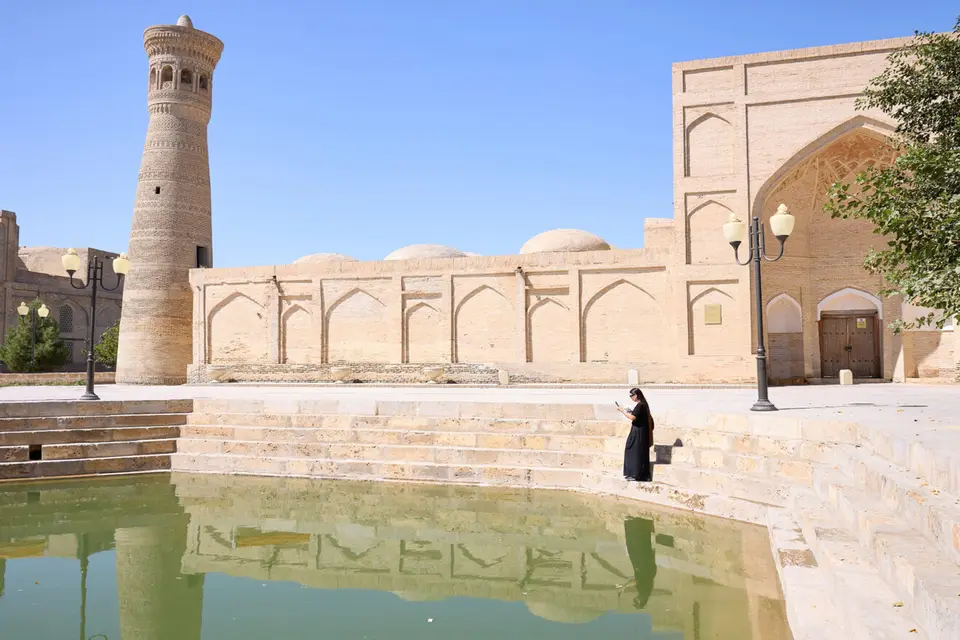
Magok means “pit” or “hollow”, and attori refers to the dealers in herbs, spices and perfumes (attor) whose market once stood here. The name describes what you see: the mosque lies in a hollow, its entrance reached by steps leading down from the surrounding square. Over the centuries the ground level of Bukhara rose by several metres as buildings collapsed and were rebuilt on their own rubble, and by the early 20th century the mosque was half buried in sand and debris.
In the 1930s archaeologists led by Vasily Shishkin cleared the site and studied its layers. Beneath the mosque they found the remains of earlier structures, which have been interpreted as a pre-Islamic temple, possibly Zoroastrian, and a still earlier building. Medieval historians wrote that before Islam a market of idols was held in this area, and that a fire temple once stood here, so the excavations seemed to confirm the old texts.
The 12th-century facade
The southern facade is the jewel of the building. It was built in the Karakhanid period, in the 12th century, the same era as the Kalyan minaret, and survived when the rest of the mosque was rebuilt in the 16th century.
The portal is framed by bands of carved brick and terracotta panels with intricate geometric and plant designs: star patterns, interlacing, rosettes and stylised leaves. Small inserts of turquoise-glazed tiles add touches of colour. The decoration is shallow and delicate, so it changes greatly with the light; it is at its best when the sun strikes at an angle in the morning or late afternoon, bringing out the relief.
The eastern side, with its own portal, dates from a 16th-century rebuilding in the Shaybanid era, when the mosque was given its present domed interior.
A shared place of prayer?
A local tradition says that for a time in the past the mosque was shared with Bukhara’s Jewish community, who prayed there in the evening while Muslims prayed during the day, until the Jews were able to build their own synagogue. There is no firm evidence for this, but the story is often told and reflects the long coexistence of different communities in this quarter, close to the old Jewish quarter.
The carpet museum
The mosque no longer serves for worship. Its interior holds a museum of carpets displaying traditional pile carpets, flat-weaves and textiles from the Bukhara region and from the Turkmen, Uzbek and Karakalpak traditions. It is small but well chosen and gives a useful introduction before shopping in the trading domes. From inside you can also see the excavated levels below the floor.
Reading the layers of Bukhara
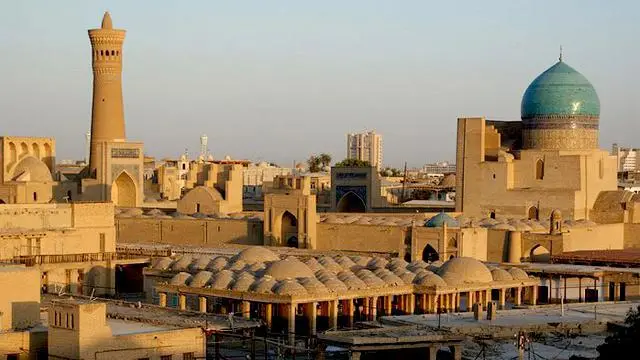
Magoki-Attori is the best place in the city to understand how old Bukhara is. The oasis has been settled for well over two thousand years, and the earliest known Bukhara stood around the area of the Ark and this market quarter. Sogdian merchants, Arab conquerors in the 8th century, the Samanid court of the 9th and 10th centuries, the Karakhanids, the Mongols and the Shaybanids all left their traces in the same few square kilometres. Standing at the bottom of the pit and looking up at street level, you see literally how the city of each era was built on the ruins of the one before.
Practical information
Location: in the old city between Lyabi-Hauz and the Toki Sarrafon dome, just a few minutes’ walk from each.
Tickets: the exterior can be seen for free from the square; the carpet museum has a small fee.
Time needed: 15–30 minutes.
Tips: step back to the top of the stairs to appreciate how far below today’s ground the 12th-century facade lies. Around the mosque, the paved square was excavated to reveal the remains of old foundations and a lane of shops; walk around the whole site. The surrounding area has several restored caravanserais and craft workshops.
Frequently asked questions
Why is the Magoki-Attori mosque below ground level?
Over the centuries the city’s ground level rose by several metres as buildings were rebuilt on their own debris. The mosque was excavated from the sand in the 1930s.
How old is the Magoki-Attori mosque?
The carved southern facade dates from the 12th century; the rest was rebuilt in the 16th century. Older temple remains were found beneath it.
Is Magoki-Attori still a mosque?
No. It now houses a small carpet museum.
Rules, timetables and prices change. We check this page regularly, but always confirm entry requirements with official sources before you travel.