Bukhara · Sights
Abdulaziz Khan Madrasah, Bukhara
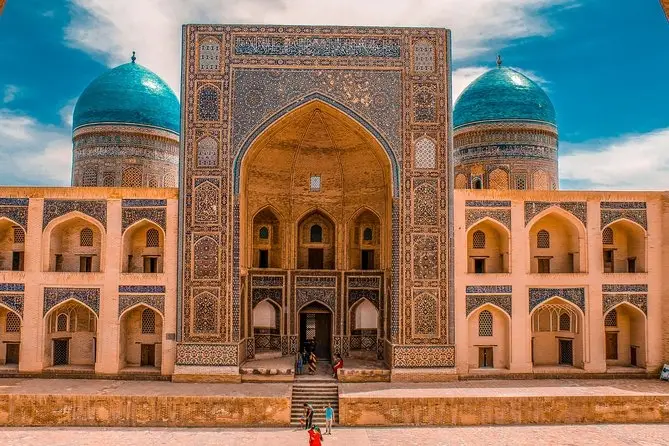
The Abdulaziz Khan madrasah of 1652, the richest decorated madrasah in Bukhara, with its stalactite portal, painted interiors and unusual images, facing the Ulugbek madrasah.
The Abdulaziz Khan madrasah (1652) is the most lavishly decorated madrasah in Bukhara. Built by the Ashtarkhanid ruler Abdulaziz Khan opposite the 15th-century Ulugbek madrasah, it has a tall portal filled with stalactite vaulting, tilework with birds, vases and even dragons, and painted interiors. Its decoration was never fully finished. Allow 20–30 minutes; it usually houses craft shops and exhibitions.
History
Abdulaziz Khan ruled Bukhara from 1645 to 1680 under the Ashtarkhanid (Janid) dynasty, which had replaced the Shaybanids at the start of the 17th century. Like many rulers before him, he sought to leave his mark with a great building. He chose a site directly opposite the Ulugbek madrasah, so that his new madrasah would form a kosh, a facing pair, with the older building, and so that comparison with Timur’s famous grandson would be unavoidable.
The madrasah was completed in 1652, but the decoration of some parts was never finished, and in places you can still see bare brick where tiles were meant to go. Political troubles at the end of Abdulaziz Khan’s reign, when he abdicated and left for pilgrimage to Mecca, are often given as the reason.
The portal
The portal is higher than that of the Ulugbek madrasah opposite, and it is meant to dominate. Its deep arch is filled with muqarnas, stalactite-like cells that cascade down from the top, covered in tiles. The facade uses a wide palette, yellow, green, white, blue and turquoise, and the designs move away from the strict geometry of the Timurid period towards flowers, vases, trees and twisting stems.
Look carefully and you will find living creatures among the ornament: birds and, according to many descriptions, small Chinese-style dragons and a mythical bird in the tiles over the entrance. Such motifs, rare on religious buildings, show the influence of Indian, Chinese and Persian art on 17th-century Bukhara, then at the heart of busy trade routes. They also suggest a relaxed attitude to traditional rules, something seen in the same period on the Nadir Divan-Begi madrasah and on the Sher-Dor madrasah in Samarkand.
Inside
The courtyard follows the usual plan, with two levels of student cells and large halls in the middle of each side. The special feature is the interior decoration of the halls and the mosque: walls and vaults covered with painted plaster and gilding, landscapes, vases and flowers, with carved ganch (alabaster) and stalactite vaults. Some of the painted scenes recall Mughal Indian art. Not all rooms are open, but those that are give an idea of the luxury of 17th-century Bukhara.
The cells are used by craftspeople and shops, selling woodcarving, miniatures, ceramics and textiles. At times the madrasah has also housed a museum of woodcarving and decorative arts. It is a pleasant place to watch artisans at work.
Comparing the pair
Standing between the two madrasahs is one of the best lessons in Central Asian architecture. Ulugbek’s building of 1417 is balanced, restrained and mathematical, with geometric tilework in blue and white. Abdulaziz Khan’s of 1652 is taller, more ornate and more colourful, with flowing plant patterns and figures. One expresses the scientific confidence of the Timurid age; the other the wealth and taste for luxury of the later khanate. Spend a few minutes looking from one portal to the other before you go inside either.
Practical information
Location: just north of the Toki Zargaron dome, opposite the Ulugbek madrasah, a few minutes east of Poi Kalyan.
Tickets: small fee for the courtyard and exhibitions; shops are free to browse.
Time needed: 20–30 minutes.
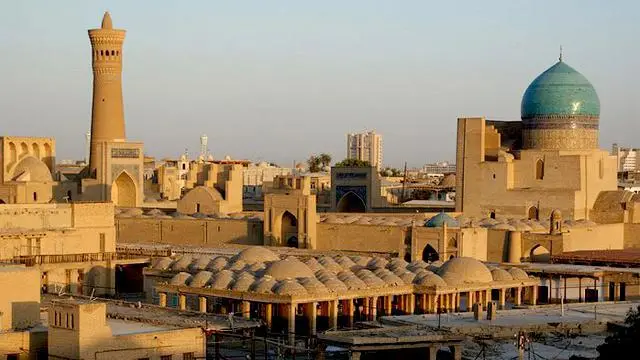
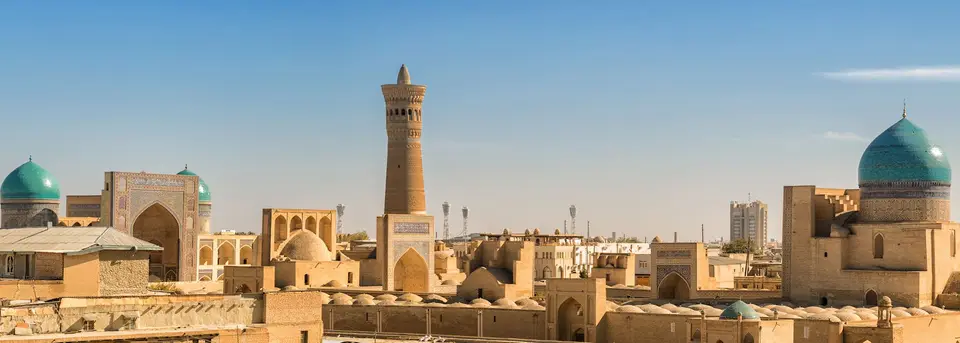
Tips: bring binoculars or use your camera’s zoom to find the birds and dragons in the portal tilework. Combine with the trading domes and the Kalyan minaret, which rises just to the west.
Frequently asked questions
When was the Abdulaziz Khan madrasah built?
In 1652, by the Ashtarkhanid ruler Abdulaziz Khan, opposite the 1417 Ulugbek madrasah.
Why is the Abdulaziz Khan madrasah unfinished?
Parts of its decoration were never completed, traditionally explained by the troubles at the end of Abdulaziz Khan’s reign.
What is special about its decoration?
The stalactite portal, the rich colours, flowers and vases, and rare images of birds and dragons, influenced by Indian and Chinese art.
Rules, timetables and prices change. We check this page regularly, but always confirm entry requirements with official sources before you travel.