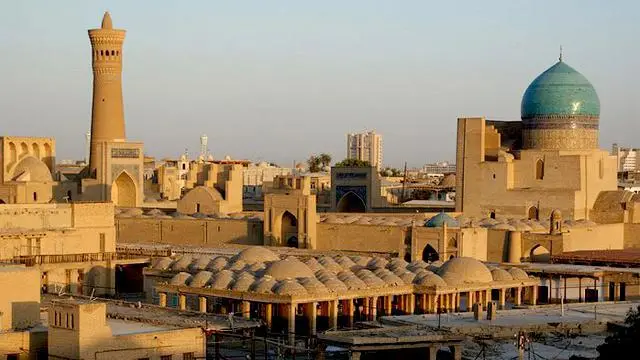
Bukhara · Sights
Ulugbek Madrasah, Bukhara
The Ulugbek madrasah of Bukhara, built in 1417 and the oldest surviving madrasah in Central Asia, its founder, its inscriptions and its pairing with the Abdulaziz Khan madrasah.
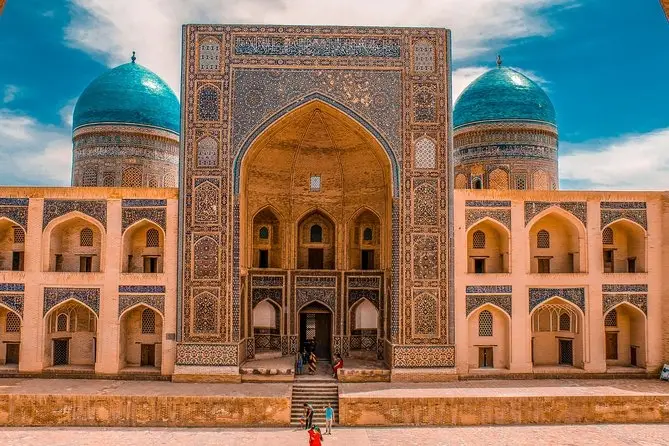
The Ulugbek madrasah in Bukhara was built in 1417 by Ulugbek, Timur’s grandson, astronomer and ruler of Samarkand. It is the oldest of the three madrasahs he founded and is often described as the oldest surviving madrasah in Central Asia. It faces the later Abdulaziz Khan madrasah across a small square near Toki Zargaron. Allow 20–30 minutes.
Ulugbek and Bukhara
Ulugbek (1394–1449), grandson of Timur, governed Samarkand and its lands for nearly forty years. He is remembered less as a warrior than as a scholar: an astronomer and mathematician who built a great observatory and produced a star catalogue of unprecedented accuracy. He founded three madrasahs, in Bukhara (1417), Samarkand (1417–1420) and Gijduvan (1433), to promote the teaching of sciences alongside religion.
The Bukhara madrasah is the earliest and the smallest. It is much more modest than its grand Samarkand twin on the Registan, but it is better preserved in its original form, and it set a model for the Timurid madrasah. Its architect, according to an inscription, was Ismail ibn Tahir ibn Mahmud Isfahani, from a family of builders from Isfahan.
The building
The madrasah is a compact two-storey building around a square courtyard, with student cells on two floors, a mosque and a lecture hall on either side of the entrance, and a monumental portal. The portal is covered with tile mosaic and glazed brick in deep blue, turquoise and white, with geometric stars and floral designs. Above the entrance a tile inscription is often quoted as Ulugbek’s motto:
> “Striving for knowledge is the duty of every Muslim man and woman.”
The saying, attributed to the Prophet, sums up Ulugbek’s ideals and is frequently cited in Uzbekistan today. The wooden doors are carved with fine patterns and inscriptions. The building was repaired in the 16th century, when parts of the decoration were renewed, and restored again in the 20th century.
The kosh ensemble
In 1652 the Ashtarkhanid ruler Abdulaziz Khan built a larger madrasah directly opposite, so that the two portals face each other across a narrow square. This kind of face-to-face pairing is called a kosh (“pair”). The contrast is striking: the 15th-century Ulugbek madrasah is restrained and harmonious, its decoration mostly geometric, while the 17th-century Abdulaziz Khan madrasah is taller, richer and more exuberant, with figurative and floral motifs. Standing between them, you can see two centuries of change in Central Asian architecture.
Teaching in a Timurid madrasah
A madrasah was a college, not a mosque. Students, all male, arrived as teenagers and could stay for many years, living two or three to a cell, cooking for themselves and studying with a succession of teachers. The curriculum began with Arabic grammar and the Quran and went on to Islamic law, theology and the traditions of the Prophet. Ulugbek wanted more: under his patronage, mathematics and astronomy were also taught, and some of the scholars who worked at his observatory in Samarkand were trained in these schools. The madrasah was financed by a waqf, a religious endowment of shops, land and baths whose income paid the teachers and fed the students.
What you can see today
The courtyard and some rooms are open to visitors. A small museum has at times displayed exhibits on the restoration of Bukhara’s monuments and on the madrasah itself, and some cells hold craft shops. What is on display varies, so check on arrival. The real attraction is the building itself: its portal, its proportions and the quiet courtyard.
Practical information
Location: just north of the Toki Zargaron trading dome, a few minutes’ walk east of Poi Kalyan.
Tickets: a small fee; a combined ticket with the Abdulaziz Khan madrasah may be available.
Time needed: 20–30 minutes for both madrasahs.
Photos: the narrow square makes it hard to fit the whole portal in a photograph; a wide-angle lens helps. Because the two portals face each other, one of them is always in shade; visit once in the morning and pass again in the afternoon to see both in sunlight.
Combine with: the trading domes, the Kalyan minaret and the Mir-i-Arab madrasah. In Samarkand, compare it with Ulugbek’s much larger madrasah on the Registan.
Frequently asked questions
Is the Ulugbek madrasah the oldest in Central Asia?
It is often described as the oldest surviving madrasah in Central Asia, built in 1417.
What is written on the Ulugbek madrasah?
Over the entrance is the saying “Striving for knowledge is the duty of every Muslim man and woman”.
How is it different from the Ulugbek madrasah in Samarkand?
The Bukhara madrasah is smaller and earlier, and better preserved in its original form; the Samarkand one on the Registan is much larger.
Rules, timetables and prices change. We check this page regularly, but always confirm entry requirements with official sources before you travel.