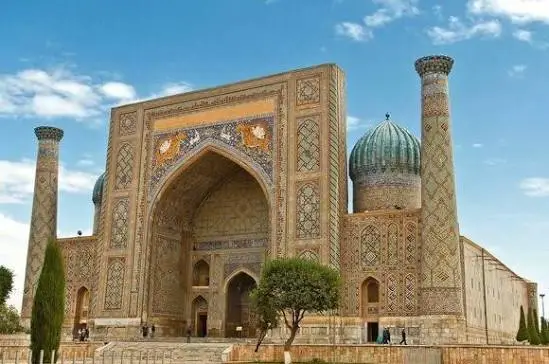
Samarkand · Sights
Tilya-Kori Madrasah and its golden mosque
The Registan’s third madrasah, which doubled as Samarkand’s Friday mosque and hides a gold-covered prayer hall.
Tilya-Kori (“gilded”) is the madrasah on the north side of Samarkand’s Registan, built in 1646–1660 by the governor Yalangtush Bahadur. It was both a college and the city’s main Friday mosque. Its prayer hall is decorated with gold-leaf ornament in the kundal technique, restored in the 20th century. Entry is on the combined Registan ticket.
History
By the mid-17th century Bibi-Khanym, Timur’s great mosque, was in ruins, and Samarkand needed a new Friday mosque where the whole male population could gather for the noon prayer. Yalangtush Bahadur, who had already built the Sher-Dor madrasah, answered with a building that combined the two functions: a madrasah with student cells around a courtyard, and on its west side a large domed mosque with galleries.
Construction began in 1646 and continued until about 1660. Yalangtush died before the decoration was finished, and the dome over the mosque was never completed in its intended form; the outer dome you see today was added during restoration in the 20th century.
The golden interior
The highlight of Tilya-Kori is its mosque. The walls and the inner dome are covered with painted and gilded ornament in the kundal technique, in which patterns are raised in relief with a paste and then painted and covered with gold leaf. The effect, under the light from the windows, is of a room glowing in gold and deep blue. The pattern on the inside of the dome uses converging lines that make the flat ceiling look much deeper than it is.
Much of the original decoration had been damaged by earthquakes and neglect. During the 1970s restoration, craftsmen recreated the kundal work using traditional methods and gold leaf, which is why the colours look so fresh today. The marble minbar (pulpit) and the mihrab niche are also worth a close look.
The facade and courtyard
The facade is long and low compared with the other two madrasahs, so that it closes the north side of the square rather than competing with Ulugbek and Sher-Dor. It has a central portal, two storeys of arched niches and short corner towers. The courtyard is wide and planted with trees.
Many former student cells now hold shops selling suzani, ceramics, carpets and souvenirs. One of the galleries houses a small exhibition of historical photographs showing the Registan in the late 19th and early 20th centuries, before and during restoration: half-collapsed portals, leaning minarets and a busy market in the square. It is one of the best ways to understand how much of today’s ensemble is the result of careful rebuilding.
Visiting
Tilya-Kori is in the centre of the Registan as you face it from the viewing platform. Visit the mosque first, before the crowds, and allow time for your eyes to adjust to the light inside. Photography is usually allowed. Cover shoulders and knees in the mosque, and keep your voice down if people are praying.
The building faces south, so it receives sun for most of the day; midday light is good for the facade, and late afternoon makes the courtyard pleasant. Combine it with the other two madrasahs on the same ticket.
Tilya-Kori in the life of the city
For more than two centuries Tilya-Kori was where Samarkand gathered on Fridays. Merchants from the market around the Registan, craftsmen from the surrounding quarters and scholars from the madrasahs prayed together in its courtyard and hall, which could hold a large congregation. Its role as the city’s main mosque continued until the late 19th century, when new mosques were built and the Registan gradually became a monument.
In the Soviet period religious use stopped and the madrasah became part of the museum reserve. The gilded mosque was restored as a showcase of traditional craftsmanship, and today it is one of the most photographed interiors in Uzbekistan. When you visit, look for the contrast between the restrained facade outside and the overwhelming richness inside, a deliberate effect that guided worshippers from the noise of the bazaar into a space of light and gold.
Nearby
Tilya-Kori sits between the Ulugbek and Sher-Dor madrasahs on the same ticket. From the Registan, the pedestrian Tashkent Street leads north-east to Bibi-Khanym and Siab Bazaar in about 15 minutes, lined with cafés and souvenir shops; Gur-Emir is a ten-minute walk in the other direction. Evening is a good time to return.
Frequently asked questions
What does Tilya-Kori mean?
It means “gilded” or “covered with gold”, after the gold-leaf decoration of its mosque.
Is the gold in Tilya-Kori real?
Yes, the kundal decoration uses real gold leaf over relief patterns. Most of what you see was restored in the 20th century using traditional methods.
Is Tilya-Kori still a mosque?
It is now part of the Registan museum complex and is visited by tourists, but it keeps its mosque interior. Behave as you would in a mosque.
Rules, timetables and prices change. We check this page regularly, but always confirm entry requirements with official sources before you travel.