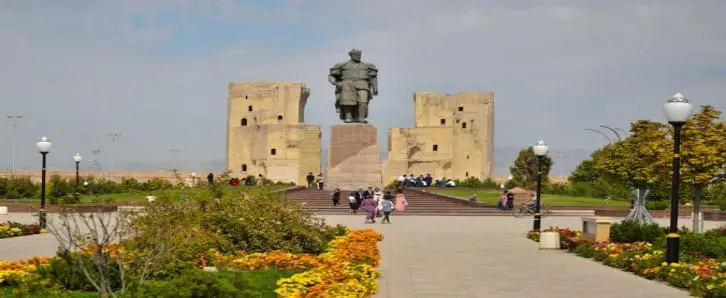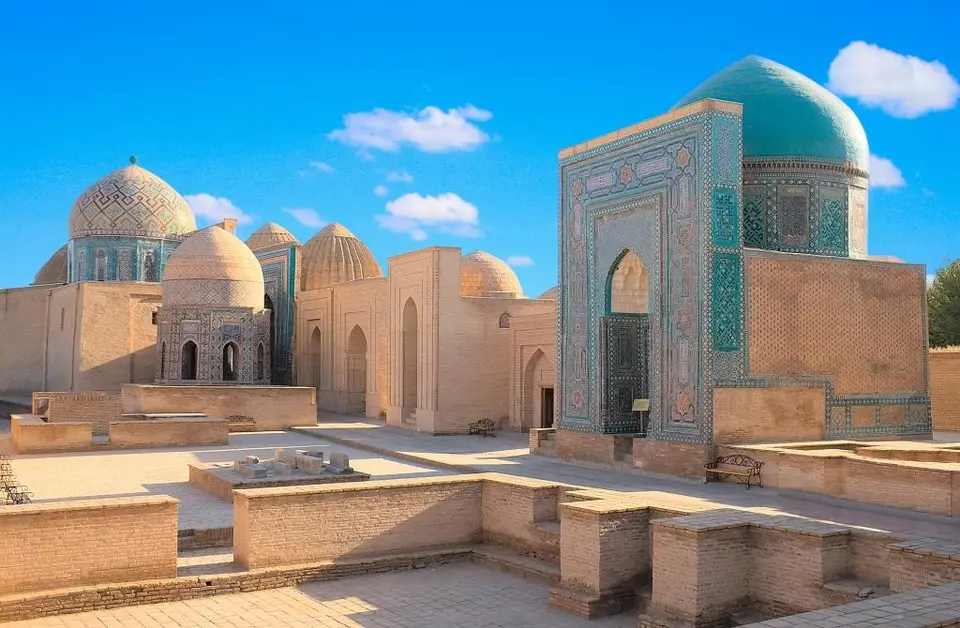
Old Nasaf · Uzbekistan
Karshi travel guide
The capital of Kashkadarya, with a 16th-century brick bridge and mosques from the age of Abdullah Khan.
Karshi (Qarshi) is the capital of the Kashkadarya region in southern Uzbekistan, the successor of the medieval city of Nasaf. Its main sights are the 16th-century Kok Gumbaz mosque, a brick bridge over the Kashkadarya and several madrasahs. High-speed trains run from Tashkent; Shakhrisabz is about 1.5 hours away.
Karshi lies in the oasis of the Kashkadarya river, on the old route between Samarkand and the Amu Darya crossings to Afghanistan. The city of Nasaf (also called Nakhshab) stood here in the early Islamic centuries and produced a line of scholars known by the name al-Nasafi. In the 14th century the Mongol khans built a palace (qarshi) nearby, which gave the town its modern name.
Today Karshi is a regional capital with an economy based on natural gas and agriculture. It is rarely on tour itineraries, which means its monuments are quiet and its bazaar entirely local. It makes an interesting stop on the road between Bukhara and Shakhrisabz, or on the way south to Termez.
- Time needed
- Half a day
- Best time
- March–May and October–November (summers are very hot)
- Getting there
- High-speed and regular trains from Tashkent via Samarkand; domestic flights; about 1.5 hours by road from Shakhrisabz and 3 hours from Bukhara.
Don’t miss
What to see in Karshi
- 01
Kok Gumbaz mosque
A Friday mosque from the late 16th century, under a large blue dome.
- 02
Karshi bridge
A long brick bridge over the Kashkadarya with pointed arches, built in the 16th century and still standing.
- 03
Madrasahs of the old town
Several 16th–20th-century madrasahs, some used as museums or workshops.
- 04
Regional museum
Archaeology of ancient Nasaf and crafts of Kashkadarya, including carpets and embroidery.
Monuments of Karshi
Karshi’s monuments date mostly from the Shaybanid period, when the city was an important stronghold of the Bukhara Khanate. The Kok Gumbaz mosque, attributed to the reign of Abdullah Khan II in the late 16th century, is the best known: a large domed prayer hall behind a portal, comparable in plan to the Friday mosques of Shakhrisabz and Bukhara. The brick bridge over the Kashkadarya, also from the 16th century, is one of the few historic bridges in Uzbekistan that still carries traffic over the river on its original arches.
Several smaller madrasahs and mosques from the 17th to early 20th centuries survive in the old town, and a reconstructed citadel area has been opened in recent years. The regional museum covers the archaeology of ancient Nasaf.
Where Karshi fits in a trip
For most travellers Karshi is a stop rather than a destination. It works well on two routes:
- Bukhara → Karshi → Shakhrisabz → Samarkand: a southern alternative to the direct Bukhara–Samarkand road, adding Karshi and Shakhrisabz in one long day or two shorter ones.
- Samarkand → Karshi → Termez: on the way south to the Buddhist and Islamic sites of Surkhandarya.
The high-speed train from Tashkent makes Karshi reachable in a few hours, which is useful if you want to start a southern loop from here.
Practical tips
Kashkadarya is one of the hottest parts of the country; from June to August avoid sightseeing in the middle of the day. English is rarely spoken, so travel with a guide or a driver who can help. The region is known for its carpets and woven goods; the bazaar is the best place to see them.
Karshi: frequently asked questions
Is Karshi the same as Qarshi?
Yes. Qarshi is the official Uzbek spelling; Karshi is the older Russian-based spelling still used in many English sources.
How far is Karshi from Shakhrisabz?
Roughly 100 km, about 1.5 hours by road.
Is there a high-speed train to Karshi?
Yes, high-speed trains run between Tashkent and Karshi via Samarkand. Check the current timetable and frequency.
Nearby
Continue your journey