Gateway to the Nuratau · Uzbekistan
Navoi travel guide
A modern city between Samarkand and Bukhara, and the starting point for petroglyphs, caravanserais and the Nurata mountains.
Navoi is a modern industrial city between Samarkand and Bukhara, named after the poet Alisher Navoi. The city itself has little to see, but it is the nearest base for the Sarmishsay petroglyphs, the 11th-century Rabati Malik caravanserai and the road to Nurata and Lake Aydarkul. High-speed trains stop here.
Navoi was built in the second half of the 20th century, around a power station, chemical plants and the mining industry of the Kyzylkum desert. Its wide avenues and Soviet-era apartment blocks have nothing of the Silk Road about them, and most travellers pass straight through on the train between Samarkand and Bukhara.
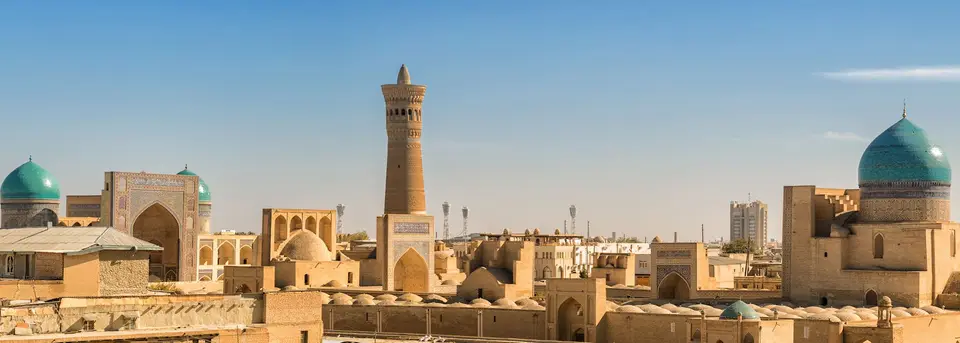
The region around it, however, is one of the richest in Uzbekistan for travellers who like archaeology and landscape. In the foothills of the Karatau to the north-east, the gorge of Sarmishsay holds thousands of rock carvings. On the old road to Bukhara stands the portal of Rabati Malik, a royal caravanserai of the Karakhanid era, and its domed water cistern. Further north lie the town of Nurata, the villages of the Nuratau mountains and the yurt camps on the shore of Lake Aydarkul.
- Time needed
- Half a day to one day
- Best time
- April–May and September–October
- Getting there
- High-speed and regular trains on the Tashkent–Samarkand–Bukhara line stop at Navoi; Navoi airport has a few passenger flights; about 1.5 hours by road from Bukhara.
Don’t miss
Sights in Navoi
Don’t miss
What to see in Navoi
- 01
Sarmishsay petroglyphs
A gorge about 40 km from Navoi with thousands of rock carvings from the Bronze Age onwards.
- 02
Rabati Malik caravanserai
The monumental portal of an 11th-century royal caravanserai and the domed cistern (sardoba) opposite.
- 03
Road to Nurata
A drive across the steppe to Nurata’s fortress and holy spring, and on to the Nuratau villages and Lake Aydarkul.
How to fit Navoi into a trip
You rarely need to spend a night in Navoi itself. The usual ways to see its surroundings are:
- On the road between Samarkand and Bukhara: stop at Rabati Malik and its cistern, which stand beside the highway west of the city, and add Sarmishsay if you start early.
- On the way to Nurata and Aydarkul: drive north from Navoi or from Samarkand, sleep in a guesthouse in the Nuratau mountains or a yurt camp near the lake, and continue to Bukhara the next day.
A car with a driver makes both options easy. Sarmishsay requires a short drive on a rough road and some walking on stony ground.
The poet behind the name
The city is named after Alisher Navoi (1441–1501), the poet and statesman of Timurid Herat who is considered the founder of literary Uzbek. He wrote in Chagatai Turkic at a time when Persian dominated literature, and argued in his Judgement of Two Languages that Turkic was equally capable of fine poetry. His name is everywhere in Uzbekistan: on streets, parks, the opera house in Tashkent and the national library.
Practical tips
Bring water and sun protection for Sarmishsay; there is little shade and no shops in the gorge. Ask your driver to stop at the cistern opposite Rabati Malik, which is easy to miss. Navoi has hotels if you need one, but for atmosphere most travellers prefer to stay in Bukhara, Samarkand or in a Nuratau village guesthouse.
Navoi: frequently asked questions
Is Navoi worth visiting?
The city itself is modern and industrial. Its surroundings are worth it if you like rock art, Silk Road caravanserais or want to reach Nurata and Lake Aydarkul.
Do high-speed trains stop in Navoi?
Yes, most trains on the Samarkand–Bukhara line, including high-speed services, stop at Navoi. Check the current timetable.
How far is Sarmishsay from Navoi?
About 40 km, roughly an hour by road including the final rough stretch.
Nearby
Continue your journey