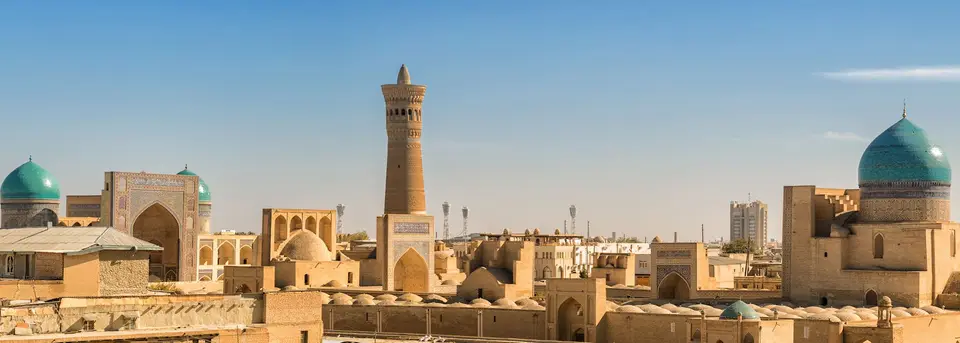
Potters and an Ulugbek madrasah · Uzbekistan
Gijduvan travel guide
A small town near Bukhara with a famous ceramics school and one of Ulugbek’s three madrasahs.
Gijduvan (Gʻijduvon) is a town about 45 km north-east of Bukhara, known for its ceramics in warm yellow, brown and green glazes, and for one of the three madrasahs built by Ulugbek (1433). A visit to a potters’ workshop, the madrasah and the Abdukhalik Gijduvani mausoleum makes a good half-day trip from Bukhara.
Gijduvan is an ordinary country town with an extraordinary craft. Its potters have developed a style of their own, quite different from the blue and turquoise of Rishtan: dishes and bowls in ochre, brown, green and cream, painted with stars, flowers and swirling patterns. The best-known workshop belongs to a family of potters who have passed down the craft for several generations and run a small museum of historic Gijduvan pieces.
The town also has a place in religious history. It is the home of Abdukhalik Gijduvani (12th century), one of the early masters of the Sufi path later known as the Naqshbandi order, and the site of the smallest of Ulugbek’s madrasahs, built beside his tomb in 1433.
- Time needed
- Half a day
- Best time
- All year; spring and autumn are most comfortable
- Getting there
- About 45 minutes by car from Bukhara on the road towards Navoi and Samarkand.
Don’t miss
What to see in Gijduvan
- 01
Ceramics workshop and museum
A family workshop where you can watch the wheel, the painting and the kiln, and see historic Gijduvan pottery.
- 02
Ulugbek madrasah
A compact 15th-century madrasah, one of three built by Ulugbek alongside those in Samarkand and Bukhara.
- 03
Abdukhalik Gijduvani mausoleum
A pilgrimage site honouring the 12th-century Sufi master, next to the madrasah.
The Gijduvan ceramics style
Gijduvan pottery uses local clay and lead-free or traditional glazes coloured with minerals, giving its typical palette of yellow, brown and green. Designs are drawn freehand with brushes made of hair, often in concentric bands and stars. In a workshop you can usually see the whole process: preparing the clay, throwing on the wheel, drying, painting and firing in a wood or gas kiln.
Pieces are sold directly in the workshop, which is a good place to buy plates, bowls and lagan (large serving dishes). Ask how to pack them for the flight home.
Ulugbek’s madrasah and the Sufi master
Ulugbek, the astronomer-ruler of Samarkand, built three madrasahs: on the Registan in Samarkand (1417–1420), in Bukhara (1417) and in Gijduvan (1433). The Gijduvan madrasah is the smallest and simplest, with a tiled portal facing the mausoleum of Abdukhalik Gijduvani. Abdukhalik is honoured as the teacher whose silent dhikr (remembrance of God) and rules of conduct shaped the Naqshbandi tradition; pilgrims often visit his tomb together with the Bahauddin Naqshband complex outside Bukhara.
Combining Gijduvan with other trips
Gijduvan is on the main road from Bukhara to Navoi and Samarkand, so it fits easily into a transfer day. A popular half-day loop from Bukhara takes in Gijduvan’s workshop and madrasah, and on the way back the Chor Bakr necropolis or the Bahauddin Naqshband complex. Gijduvan is also known for its grilled meat (Gijduvan shashlik), so time the visit for lunch. In spring and autumn the road passes orchards and cotton fields, and roadside stalls sell melons, pomegranates and local bread, so it is worth asking your driver to stop on the way back to Bukhara.
Gijduvan: frequently asked questions
How far is Gijduvan from Bukhara?
About 45 km, roughly 45 minutes by car.
What is Gijduvan ceramics?
A regional pottery style using yellow, brown and green glazes with painted stars and floral patterns, made by family workshops in the town.
How many madrasahs did Ulugbek build?
Three, in Samarkand, Bukhara and Gijduvan. The Gijduvan madrasah (1433) is the latest and smallest.
Nearby
Continue your journey