Tashkent · Sights
Courage Monument: Tashkent’s earthquake memorial
The Courage Monument in Tashkent: the earthquake of 26 April 1966, what the memorial shows, the clock stopped at 5:24, how Tashkent was rebuilt, where it is, how to get there and what is nearby.
The Courage Monument is a memorial in central Tashkent to the earthquake of 26 April 1966, which struck at 5:24 in the morning and destroyed much of the old city. Unveiled in 1976, it shows a man shielding a woman and child before a black stone cube split by a crack, with a clock face showing the time of the first shock. Entry is free.
What happened on 26 April 1966?
Just before dawn on 26 April 1966, a strong earthquake struck directly beneath Tashkent. The epicentre was shallow and under the city centre, so although the magnitude was moderate, the destruction was enormous: tens of thousands of buildings, especially traditional mud-brick houses of the old city, were destroyed or badly damaged, and some 300,000 people lost their homes. The official death toll was low for such a disaster, partly because many houses were single-storey. Aftershocks continued for months.
What the monument shows
- The cube: a block of dark labradorite split by a deep crack, symbolising the earth breaking open. On it, a clock face shows 5:24, the moment of the first shock, and the date.
- The figures: a bronze man stands facing the crack, protecting a woman and a child behind him: the courage of ordinary people.
- The reliefs: around the square, reliefs show the rebuilding of the city by workers from all the Soviet republics.
The memorial was created by the sculptor Dmitry Ryabichev with architects, and opened on the tenth anniversary of the earthquake.
How Tashkent was rebuilt
After the earthquake the Soviet government sent builders, engineers and money from across the USSR. Within a few years new residential districts were built, the centre was laid out with wide avenues and parks, and many of the Soviet modernist buildings that visitors see today, such as the Hotel Uzbekistan, date from this period. The Tashkent metro, opened in 1977, was built to earthquake-resistant standards. The rebuilding transformed Tashkent into the modern city it is today, but much of the old town was lost. Read more in our guide to the Tashkent metro.
Where is the Courage Monument?
In a square on the bank of the Ankhor canal, east of the Old City and not far from the Hotel Uzbekistan and Amir Timur Square. The area around it is a park with paths along the water, popular with families in the evening.
How to get there
Take a taxi or walk from Amir Timur Square (about 15–20 minutes). The nearest metro stations are in the centre, within 10–15 minutes’ walk. It fits easily into a walk between Independence Square and Amir Timur Square.
Best time to visit
Any time; the square is open and free. Evenings are pleasant, when the park along the canal fills with people. On 26 April each year, people lay flowers at the monument.
Tashkent before and after 1966
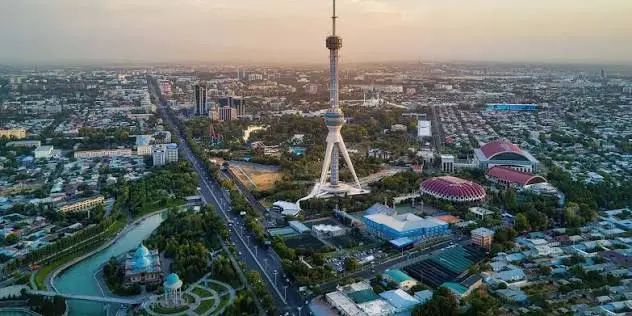
Before the earthquake, Tashkent was a city of two halves: the old city, a maze of mud-brick courtyard houses, mosques and bazaars around Chorsu, and the Russian new town laid out after 1865 with radial avenues around a central square. The earthquake hit the old city hardest. In the rebuilding, large parts of it were replaced by apartment blocks, and only pockets survived, around Chorsu Bazaar and the Khast-Imam complex. A walk from the monument to the old city shows this contrast clearly, and explains why most of Tashkent’s historic monuments are concentrated in just a few places.
Is it worth visiting?
Yes, as a short stop of 15–20 minutes: it explains why Tashkent looks the way it does, with its Soviet avenues and few old buildings. Combine it with the walk through the city centre.
What to see nearby
- Amir Timur Square and the Amir Timur Museum;
- Independence Square;
- the State Museum of History;
- the Museum of Applied Arts.
See things to do in Tashkent and our Tashkent itinerary.
Frequently asked questions
When was the Tashkent earthquake?
On 26 April 1966 at 5:24 in the morning.
What time does the clock on the Courage Monument show?
5:24, the moment of the first shock.
When was the Courage Monument unveiled?
In 1976, on the tenth anniversary of the earthquake.
Is there an entrance fee?
No. The monument stands in a public square.
Rules, timetables and prices change. We check this page regularly, but always confirm entry requirements with official sources before you travel.