Khiva · Sights
Juma Mosque of Khiva
The Juma mosque of Khiva, a hypostyle hall of more than 200 carved wooden columns, some up to a thousand years old, its history, the minaret and tips for visiting.
The Juma mosque (Friday mosque) of Khiva is a vast, low hall supported by more than 200 carved wooden columns, lit by two openings in the roof. Founded around the 10th century and rebuilt in 1788–1789, it reused columns of many periods, a few thought to be up to a thousand years old. It is one of Central Asia’s most atmospheric interiors.
A hall without portals or domes
Most famous mosques in Central Asia announce themselves with tiled portals and turquoise domes. The Juma mosque of Khiva is different. From the outside it is a plain mud-brick block in the centre of Ichan-Kala, with modest doors and a minaret. Inside, it is a single huge room, about 55 by 46 metres, with a flat wooden roof supported by rows of columns. This kind of building, a hypostyle hall, recalls the earliest mosques of the Islamic world, such as the first mosques of Arabia and the great mosque of Córdoba, and may preserve the plan of the original mosque on the site.
The mosque was first mentioned by the 10th-century Arab geographer al-Muqaddasi. It was rebuilt several times; its present form dates from 1788–1789, when it was reconstructed under Abdurakhman Mehtar, a vizier of the khanate.
The columns
The hall contains around 213 columns (sources give slightly different numbers), arranged in rows about 3 metres apart. They are made of elm, carved with plant scrolls, geometric patterns and inscriptions, standing on stone bases. When the mosque was rebuilt, the builders reused columns from earlier buildings, including the previous mosque, so the columns differ in shape, carving style and age.
Specialists have dated a small number of columns to the 10th–11th centuries, a few others to the 14th–16th centuries, and the majority to the 18th century and later. Some of the oldest are believed to have come from the ancient city of Kath, the earlier capital of Khorezm. Look for the differences: the oldest columns are slender, with finely carved, worn surfaces and Kufic inscriptions; later ones are thicker, with bulb-shaped lower sections and dense floral carving. Many columns have a pear-shaped swelling at the base, a Khorezmian feature that protected the wood from damp and termites.
Walking slowly among them, you can see the history of Khorezmian woodcarving over nearly a thousand years in one room.
Light and atmosphere
The hall is dim. Light enters through two openings in the roof, above small courtyards with trees, and through the doors. Shafts of light fall between the columns, especially in the morning and around midday, creating a forest of light and shadow that photographers love. The floor is covered in carpets in some areas. The mosque no longer functions as the main Friday mosque, but its spiritual atmosphere remains, and visitors usually lower their voices. Take a few minutes to sit quietly at the edge of the hall and let your eyes adjust.
The minaret
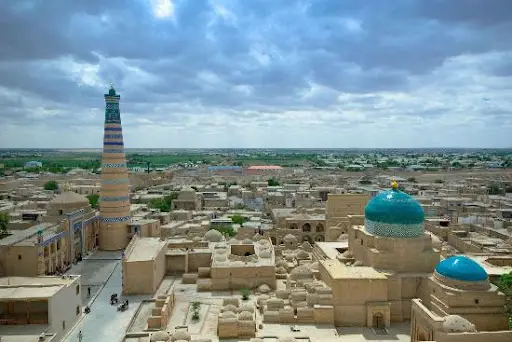
Beside the mosque stands its minaret, about 33 metres high, built at the same time as the 18th-century reconstruction. It is decorated with bands of glazed brick and tiles. When open, climbing its dark, steep, narrow spiral staircase rewards you with views over the roofs of Ichan-Kala; it usually needs a separate ticket. Check on site, as access varies.
Visiting
Location: in the centre of Ichan-Kala, on the main street between the west and east gates.
Tickets: included in the Ichan-Kala combined ticket; the minaret, if open, is extra.
Time needed: 20–30 minutes, longer if you photograph.
Best time: late morning, when the sun is high and light beams fall through the roof openings.
Etiquette: modest dress; keep your voice low.
Nearby: the Kunya Ark to the west, the Pahlavan Mahmud mausoleum and the Islam Khoja minaret to the south-east, and the Tash-Hauli palace to the east.
Frequently asked questions
How many columns does the Juma mosque in Khiva have?
Around 213 carved wooden columns; sources vary slightly. A few are thought to date from the 10th–11th centuries.
How old is the Juma mosque?
The mosque is first recorded in the 10th century; its present building dates from a reconstruction in 1788–1789.
Can you climb the Juma mosque minaret?
Sometimes, with a separate ticket. Access varies, so check on site.
Rules, timetables and prices change. We check this page regularly, but always confirm entry requirements with official sources before you travel.