Samarkand · Sights
Amir Timur Monument in Samarkand
The seated bronze statue of Amir Timur on Samarkand’s university boulevard, why Uzbekistan raised monuments to Timur after independence, and how to combine it with the Gur-e-Amir and the Russian quarter.
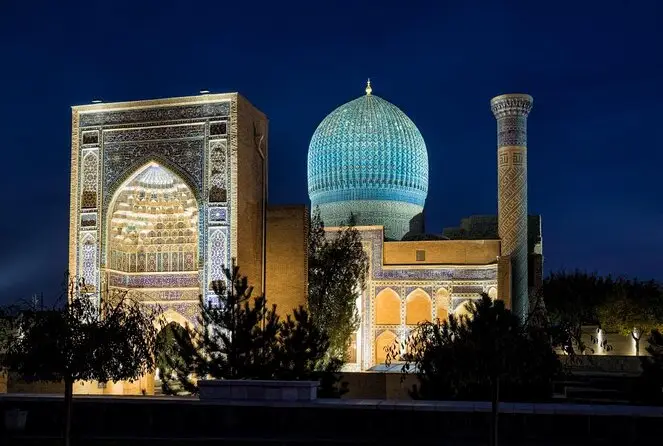
The Amir Timur Monument in Samarkand is a large seated bronze statue of Timur (Tamerlane) on the boulevard near Samarkand State University, a few minutes’ walk from his tomb, the Gur-e-Amir. It was raised in the 1990s, when independent Uzbekistan made Timur a national hero; Tashkent and Shakhrisabz have their own statues of him.
Why are there statues of Amir Timur in Uzbekistan?
In Soviet times Timur was presented mainly as a cruel conqueror, and monuments to him were unthinkable. After independence in 1991, Uzbekistan looked for national heroes, and Timur, who made Samarkand the capital of an empire stretching from Anatolia to India and filled it with great buildings, became the central figure. In 1996 the country celebrated the 660th anniversary of his birth, and statues went up in the three cities most connected with him:
- Tashkent, an equestrian statue on Amir Timur Square, next to the Amir Timur Museum;
- Shakhrisabz, his birthplace, a standing statue before the ruins of the Ak-Saray Palace;
- Samarkand, his capital, the seated statue.
Each shows a different side of him: the warrior on horseback, the ruler standing, and here, in his capital, the sovereign seated on his throne. For his life and legacy, read our page on Amir Timur.
What the Samarkand statue looks like
The bronze figure sits on a throne on a high pedestal, wearing a robe and a domed hat, one hand resting on his knee and the other on the hilt of a sword. The face follows the reconstruction made by the Soviet anthropologist Mikhail Gerasimov, who studied Timur’s skull after the opening of the tomb in the Gur-e-Amir in 1941: a broad face, a short beard and a stern expression. Gerasimov’s reconstruction is the basis of most modern images of Timur.
The monument stands at the head of a long, tree-lined boulevard, with flower beds and fountains around it. It is a favourite place for wedding photographs: on Saturdays especially, you may see several couples and their families posing in front of it.
The legend of Timur’s tomb, 1941
Guides often tell the story of June 1941, when Soviet scientists opened Timur’s tomb in the Gur-e-Amir. According to legend, an inscription warned that whoever disturbed the tomb would unleash an invader more terrible than Timur himself. Two days later Germany invaded the Soviet Union. The remains were reburied with Islamic rites in 1942, and the Soviet victory at Stalingrad is said to have followed soon after. Historians treat the curse as legend, but it is one of the most popular stories in Samarkand.
What to see near the Amir Timur Monument
The statue is close to the Gur-e-Amir, where Timur is buried, and to the Rukhabad Mausoleum and the Ak-Saray Mausoleum. To the west lies the Russian quarter with its boulevards and the St Alexius Cathedral.
A good evening walk: watch the Gur-e-Amir lit up after dark, then stroll along the boulevard to the statue and on to a café in the new town.
What survives of Timur’s Samarkand
The statue is a good starting point for understanding how Samarkand looked in Timur’s time. He brought craftsmen from the lands he conquered, from Persia, Azerbaijan, India and Syria, and set them to work on mosques, madrasahs, palaces and gardens. Of his own buildings, the Bibi-Khanym Mosque, the Gur-e-Amir and several tombs in Shah-i-Zinda survive; his gardens outside the city, described by the Castilian ambassador Clavijo in 1404, have disappeared. The Registan as we see it today was largely built by his grandson Ulugbek and by later rulers.
Where it is and best time to visit
Location: on the boulevard by Samarkand State University, between the Gur-e-Amir and the Russian quarter.
Tickets: free; it stands in a public square.
Time needed: 10–15 minutes.
Best time: early morning or the evening, when the square is lit. Midday in summer is hot and shadeless.
See also things to do in Samarkand and the Samarkand itinerary.
Frequently asked questions
Where is the Amir Timur statue in Samarkand?
On the boulevard by Samarkand State University, a few minutes’ walk from the Gur-e-Amir, Timur’s tomb.
How many statues of Timur are there in Uzbekistan?
The best known are three, raised in the 1990s: an equestrian statue in Tashkent, a standing one in Shakhrisabz and the seated one in Samarkand.
Whose reconstruction is Timur’s face based on?
Mikhail Gerasimov’s reconstruction from Timur’s skull, made after the tomb was opened in 1941.
Is the Amir Timur statue in Samarkand free to visit?
Yes. It stands on a public boulevard and can be visited at any time.
When was the Amir Timur statue in Samarkand built?
In the 1990s, around the 660th anniversary of Timur’s birth celebrated in 1996.
How long do I need at Amir Timur Monument, Samarkand?
10–15 minutes.
Rules, timetables and prices change. We check this page regularly, but always confirm entry requirements with official sources before you travel.