Culture & etiquette
Amir Timur (Tamerlane)
The life of Amir Timur, known in the West as Tamerlane, from his birth near Shakhrisabz to his conquests from Delhi to Ankara, his capital Samarkand and its monuments, his descendants the Timurids, and the places in Uzbekistan where his legacy can be seen today.
Amir Timur (1336–1405), known in Europe as Tamerlane, was born near Shakhrisabz and built an empire stretching from Anatolia to India, with Samarkand as its capital. He was a ruthless conqueror but also a great patron of architecture. Today he is a national hero in Uzbekistan; his tomb is the Gur-Emir in Samarkand.
Early life
Timur was born on 9 April 1336, according to tradition, near Kesh, today’s Shakhrisabz, south of Samarkand. He belonged to the Barlas, a Mongol tribe that had become Turkic-speaking and Muslim. Central Asia was then part of the fragmented Chagatai khanate, ruled by descendants of Genghis Khan, and torn by rivalries between tribal leaders.
As a young man, Timur was wounded in the right leg and arm, probably in battle, and walked with a limp for the rest of his life. His Persian name Timur-i Lang, "Timur the Lame", became Tamerlane in European languages.
Rise to power
Through alliances, betrayals and military skill, Timur rose to dominate Transoxiana, the land between the Amu Darya and the Syr Darya. By 1370 he was master of the region and made Samarkand his capital. Because he was not a descendant of Genghis Khan, he never took the title of khan. He called himself Amir ("commander") and married a Genghisid princess, which gave him the title Gurkan, "son-in-law" of the khans.
The conquests
Over the next 35 years, Timur led almost constant campaigns:
- Persia and Khorezm, including the destruction of Urgench in the 1370s–1380s.
- The Golden Horde, defeating its khan Tokhtamysh in the 1390s.
- India, sacking Delhi in 1398.
- Syria, taking Aleppo and Damascus in 1400–1401.
- Anatolia, defeating the Ottoman sultan Bayezid I at the battle of Ankara in 1402.
His wars were extremely brutal: cities were destroyed and populations massacred, and he is remembered very differently in the lands he conquered. At the same time, he brought craftsmen, architects and scholars from across his empire to Samarkand.
In February 1405, while leading an army towards China, he died at Otrar, in present-day Kazakhstan.
Samarkand, the capital
Timur wanted Samarkand to be the most magnificent city in the world. He built the vast Bibi-Khanym mosque after his Indian campaign, added mausoleums to the Shah-i-Zinda necropolis, and created gardens and palaces around the city. In Shakhrisabz, his birthplace, he built the enormous Ak-Saray palace, whose gate inscription reads: "If you doubt our power, look at our buildings."
The Castilian ambassador Ruy González de Clavijo, who visited Samarkand in 1404, left a famous description of the city, its gardens and Timur’s court.
The Gur-Emir and the curse
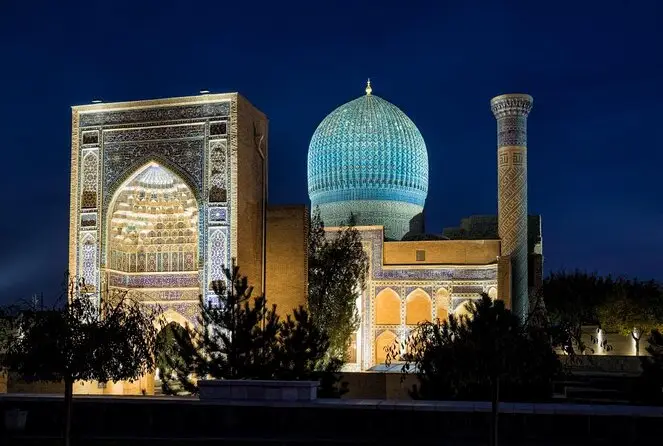
Timur was buried in the Gur-Emir mausoleum in Samarkand, originally built for his grandson Muhammad Sultan. His tomb is marked by a great slab of dark green jade. In June 1941, Soviet scientists led by Mikhail Gerasimov opened the tomb, confirming his height and his injuries. A legend says that an inscription warned that whoever disturbed the tomb would unleash an invader worse than Timur: two days later, Germany invaded the Soviet Union. The remains were reburied with Islamic rites in 1942.
The Timurids
Timur’s descendants, the Timurids, ruled Central Asia and Persia for another century. His grandson Ulugbek made Samarkand a centre of science; in Herat, Sultan Husayn Bayqara and the poet Alisher Navoi led a flowering of art and literature. A Timurid prince from the Fergana Valley, Babur, founded the Mughal empire in India, whose rulers built the Taj Mahal.
Timur in Uzbekistan today
In Soviet times, Timur was officially seen as a feudal tyrant. After independence in 1991, Uzbekistan made him a national hero, a symbol of statehood and cultural greatness. Statues of Timur stand in Tashkent, Samarkand and Shakhrisabz, and his saying "Strength lies in justice" is widely quoted.
Places to see his legacy:
- Gur-Emir, Bibi-Khanym and Shah-i-Zinda in Samarkand.
- Ak-Saray and Dorut Tilovat in Shakhrisabz.
- The Amir Timur Museum and Amir Timur Square in Tashkent.
See our Samarkand itinerary and how to get to Shakhrisabz.
Frequently asked questions
Who was Tamerlane?
Amir Timur (1336–1405), a conqueror born near Shakhrisabz who built an empire from Anatolia to India, with Samarkand as its capital.
Where is Timur buried?
In the Gur-Emir mausoleum in Samarkand.
Why is Timur called Tamerlane?
From the Persian Timur-i Lang, "Timur the Lame", because of an old wound.
Rules, timetables and prices change. We check this page regularly, but always confirm entry requirements with official sources before you travel.