Shakhrisabz · Sights
Dorus-Saodat complex, Shakhrisabz
The Dorus-Saodat complex in Shakhrisabz, with the mausoleum of Timur’s eldest son Jahangir, the Hazrati Imam mosque, and the crypt Timur prepared for himself but never used.
Dorus-Saodat (“Seat of Power”) is the dynastic burial complex that Timur built in Shakhrisabz. Its surviving parts are the mausoleum of Jahangir, Timur’s eldest son, the Hazrati Imam mosque, and an underground crypt with a marble sarcophagus that Timur prepared for himself, but he was buried in Samarkand instead. Allow 30–45 minutes.
A dynastic memorial
In 1376, Timur’s eldest and favourite son, Jahangir, died at the age of about 22. Timur, deeply grieved, ordered a great memorial complex in his home town of Kesh. Dorus-Saodat was conceived on a huge scale: a mausoleum for Jahangir, tombs for other members of the family, a mosque, a madrasah and lodgings for pilgrims. Its name, “Seat of Power”, expressed the dynasty’s claim to rule. Over the centuries most of the complex was destroyed, and today only a few parts survive.
The mausoleum of Jahangir
The Jahangir mausoleum is a tall building with a distinctive conical, ribbed dome on a high drum, a form typical of Khorezm, which suggests that craftsmen from that region, brought by Timur after his conquest, built it. The facade preserves fragments of glazed tile and brick decoration. Inside, the burial chamber holds the tomb of Jahangir; another of Timur’s sons, Umar Sheikh, who died in 1394, is also traditionally said to have been buried here, although his remains were later moved.
The mausoleum is the only substantial part of Timur’s complex still standing. It gives an idea of the scale and ambition of the original project.
Timur’s crypt
Behind the mausoleum, a small entrance leads down into an underground crypt, discovered by archaeologists in 1943. Inside lies a large marble sarcophagus with inscriptions, prepared, it is believed, for Timur himself. The crypt was found empty except for two unidentified bodies.
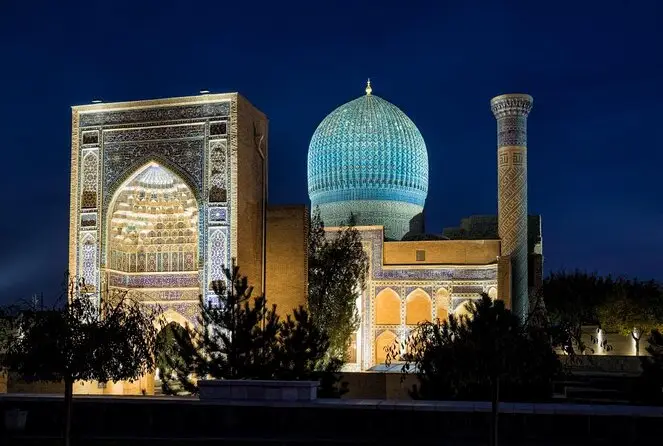
Timur had wished to be buried in his home town. But when he died in February 1405 in Otrar, on the way to campaign against China, the mountain passes between Samarkand and Kesh were blocked by snow, and his body was taken to Samarkand and buried in the Gur-Emir, the mausoleum he had built for his grandson Muhammad Sultan. The empty crypt in Shakhrisabz remains a poignant reminder of his wish.
Access to the crypt is usually allowed with a guide or attendant; the steps are steep and the space is small.
The Hazrati Imam mosque
Opposite the mausoleum stands the Hazrati Imam mosque, a later building with a carved wooden porch (aivan) and a domed hall. It is an active mosque, popular with local worshippers. Nearby are the graves of local saints and a shady courtyard with old trees.
The two burials of Timur
The story of Timur’s burial says much about the man. He planned a modest grave in his home town, near his father and teacher, yet he was laid to rest under the splendid ribbed dome of the Gur-Emir in Samarkand, beside his spiritual teacher Mir Sayyid Baraka and later joined by his sons and grandsons, including Ulugbek. When Soviet archaeologists opened his tomb in Samarkand in June 1941, a legend warned that disturbing it would bring war; days later, Germany invaded the Soviet Union. Timur was reburied with full Islamic rites in 1942. Visiting both places, the empty crypt in Shakhrisabz and the tomb in Samarkand, completes the story.
Visiting
Location: in the south-eastern part of the historic centre of Shakhrisabz, a few minutes’ walk from Dorut-Tilavat.
Tickets: a small fee may apply for the mausoleum and crypt.
Time needed: 30–45 minutes.
Etiquette: dress modestly; the mosque and tombs are places of prayer.
Tips: visit after the Ak-Saray palace and Dorut-Tilavat to complete the story of Timur’s family. If you are coming from Samarkand, finish your day at the Gur-Emir to see where Timur was finally buried. See how to get to Shakhrisabz.
Frequently asked questions
Is Timur buried in Shakhrisabz?
No. He built a crypt for himself in the Dorus-Saodat complex, but after his death in 1405 he was buried in the Gur-Emir in Samarkand.
Who is buried in the Jahangir mausoleum?
Jahangir, Timur’s eldest son, who died in 1376.
Can you visit Timur’s crypt?
Usually yes, with an attendant. The crypt holds a marble sarcophagus prepared for Timur but never used.
Rules, timetables and prices change. We check this page regularly, but always confirm entry requirements with official sources before you travel.