Gijduvan · Sights
Abdul-Khaliq Gijduvani Mausoleum and Ulugbek Madrasah, Gijduvan
The Abdul-Khaliq Gijduvani shrine and Ulugbek madrasah in Gijduvan: who Gijduvani was, the seven saints of Bukhara, history, what to see, dress code, how to get there from Bukhara and what to combine it with.
The memorial complex of Abdul-Khaliq Gijduvani in Gijduvan, about 45 km (50 minutes) north-east of Bukhara, honours a 12th-century Sufi master whose teachings shaped the Naqshbandi order. Opposite stands the smallest of the three madrasahs built by Ulugbek (1432–1433). It is one of the seven saints of Bukhara visited by pilgrims; entry to the shrine is free.
Who was Abdul-Khaliq Gijduvani?
Abdul-Khaliq Gijduvani lived in Gijduvan in the 12th century. He belonged to the line of Sufi teachers called the Khwajagan, “the masters”, and formulated principles such as silent remembrance of God (dhikr) and awareness of every breath, which Bahauddin Naqshband later built upon. He is therefore counted among the founders of the Naqshbandi tradition, today spread from Central Asia to Turkey, India, Malaysia and Indonesia.
His eight principles, known in Persian as the kalimat-i qudsiyya, include “awareness in breathing”, “watching one’s step” and “solitude in the crowd”, the idea of keeping the heart with God while living an ordinary life among people. Bahauddin Naqshband later added three more, and these eleven principles remain the basis of Naqshbandi practice.
The seven saints of Bukhara
Gijduvani is one of the seven saints (Yetti Pir) of the Bukhara region, the masters of the Naqshbandi chain whose shrines pilgrims visit in a traditional circuit, ending with Bahauddin Naqshband on the edge of Bukhara. Many pilgrims from Turkey, Pakistan, Malaysia and Indonesia follow this route.
What to see at the complex
- The shrine: the saint’s grave in a courtyard with a mosque, a pool and buildings for pilgrims, rebuilt and extended after independence.
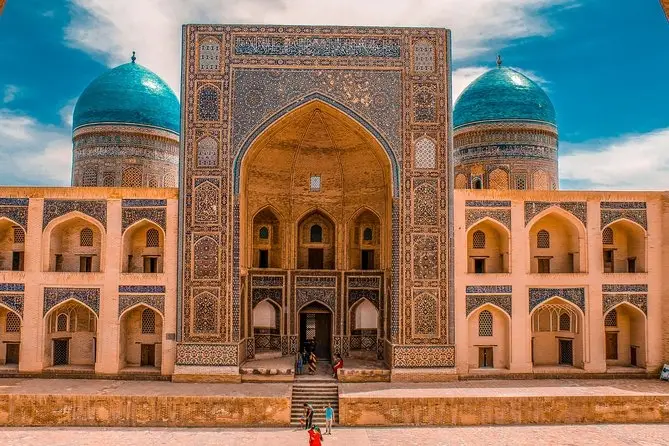
- The Ulugbek Madrasah: built in 1432–1433 by Timur’s grandson Ulugbek, the astronomer-ruler of Samarkand. He built three madrasahs: on the Registan, in Bukhara and here. This is the smallest, with a portal of glazed brick and tile mosaic in blue and turquoise.
Dress code and etiquette
It is an active place of pilgrimage. Wear long sleeves and trousers or a long skirt; women should cover their hair in the shrine area. Remove shoes where asked, keep your voice low and ask before photographing people at prayer. The shrine is free; the madrasah may charge a small fee.
How to get to Gijduvan from Bukhara
By car or taxi, about 50 minutes along the road towards Navoi; shared taxis also run from Bukhara. Gijduvan lies on the way between Bukhara and Samarkand or Nurata, so it is easy to visit on a transfer day.
Gijduvan ceramics
Gijduvan is one of Uzbekistan’s most famous ceramics centres, known for pottery in brown, ochre, yellow and green, very different from the blue-and-white of Rishtan. Family workshops show the whole process and sell their work. Most visitors combine the shrine with a workshop and lunch. See Gijduvan and Uzbek ceramics.
Best time to visit and how long to spend
The complex is open from morning to evening. Allow 30–45 minutes for the shrine and the madrasah, plus an hour if you visit a ceramics workshop. Fridays and religious holidays are busiest with pilgrims, which can be moving to see but means more crowds. Spring and autumn are the most comfortable seasons; in summer, come in the morning.
Tips for pilgrims
Pilgrims often visit the shrine as part of the circuit of the seven saints, usually starting or ending at Bahauddin Naqshband. Local custom is to recite a prayer or a passage from the Quran at the grave, walk calmly around the courtyard and leave a small donation. Groups sometimes arrange a shared meal. If you want to follow the full circuit of the seven shrines in one or two days, ask us to plan the route and driver.
Is it worth visiting?
Yes for Muslim travellers and anyone interested in Sufism, and as part of a day trip with the ceramics workshops. On its own, the madrasah is modest compared with Ulugbek’s buildings in Samarkand.
What to combine it with
- the Vabkent Minaret, a 12th-century tower on the way;
- Rabati Malik caravanserai further east;
- Bahauddin Naqshband for the full Naqshbandi story.
See day trips from Bukhara, our Islamic heritage itinerary and Uzbekistan for Muslim travellers.
Frequently asked questions
Who was Abdul-Khaliq Gijduvani?
A 12th-century Sufi master from Gijduvan whose teachings were taken up by Bahauddin Naqshband; he is counted among the founders of the Naqshbandi tradition.
Which Ulugbek madrasah is in Gijduvan?
The smallest of Ulugbek’s three madrasahs, built in 1432–1433 opposite the shrine.
How far is Gijduvan from Bukhara?
About 45 km north-east, around 50 minutes by car.
Is the Gijduvani mausoleum one of the seven saints of Bukhara?
Yes. It is one of the seven Naqshbandi shrines visited in the traditional Bukhara pilgrimage.
Is there an entrance fee?
The shrine is free; the madrasah may charge a small fee.
Rules, timetables and prices change. We check this page regularly, but always confirm entry requirements with official sources before you travel.