Khiva · Sights
Muhammad Rahim Khan Madrasah, Khiva
The Muhammad Rahim Khan madrasah facing the Kunya Ark, built by the poet-khan Feruz, the museum of his reign, and the story of Khiva under the Russian protectorate.
The Muhammad Rahim Khan madrasah (1871) faces the Kunya Ark across a square in the west of Ichan-Kala. It was built by Muhammad Rahim Khan II, a poet who wrote under the name Feruz and ruled when Khiva became a Russian protectorate in 1873. Today it houses a museum about the khan, his court and his time. Allow 30 minutes.
Feruz, the poet-khan
Muhammad Rahim Khan II (ruled 1864–1910) is one of the most interesting figures in Khiva’s history. He came to the throne young and reigned for nearly half a century, through the most dramatic change in the khanate’s history. He was a cultivated man who wrote poetry under the pen name Feruz, played music and gathered poets, musicians, historians and calligraphers at his court. He supported the writing of histories of Khorezm, the copying of manuscripts and the composition of music, and he is credited with encouraging a system of musical notation for Khorezmian melodies. Under his patronage, the first lithographic printing press in Khiva was set up, producing books of poetry.
The Russian conquest
In 1873 a Russian army under General Konstantin von Kaufman advanced across the desert and took Khiva after short resistance. Under the peace treaty, the khanate lost its lands on the right bank of the Amu Darya, paid a large indemnity, abolished the slave trade and became a protectorate of the Russian Empire. Muhammad Rahim Khan kept his throne and his court, and for the rest of his long reign Khiva lived in an unusual position: internally governed by its khan, externally controlled by Russia.
Freed captives, many of them Persians, could return home. Russian goods and influence slowly entered the city, and the khan’s successors would build the telegraph, the post office and the European-style rooms of the Nurullaboy palace.
The madrasah
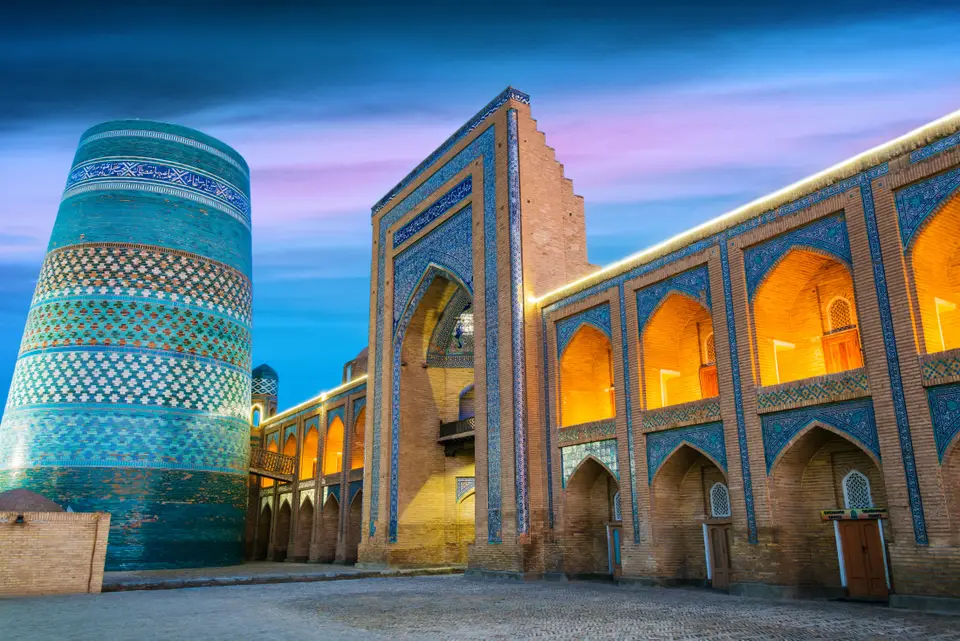
The madrasah was completed in 1871, two years before the conquest. It stands on the square opposite the eastern gate of the Kunya Ark, the khan’s residence, a deliberate choice that put the ruler’s school in front of his palace. It has some 76 cells on two floors around a courtyard, a tall portal with corner towers topped by small domes, and side facades with two levels of arched niches. The decoration is relatively restrained, with blue and white tiles on the portal and the towers.
It was one of the most important schools of the khanate, where students studied religion, law, Arabic and Persian literature. The square in front of it, between the madrasah and the Ark, was used for public gatherings, announcements and punishments.
The museum
The madrasah now houses a museum dedicated to Muhammad Rahim Khan II and the Kungrad dynasty. Exhibits include portraits and photographs of the khans and their courtiers, manuscripts and books printed at the court press, musical instruments, clothing, weapons and documents from the period of the Russian protectorate. Some displays present the poets and musicians of his court. Labelling is partly in English; a guide helps to bring the stories to life. Look out for the photographs taken in Khiva in the early 20th century, among the first images of the city, showing the khan’s court, the streets and the people of the time.
Visiting
Location: in the west of Ichan-Kala, opposite the Kunya Ark, a few minutes from the Ata Darvaza gate.
Tickets: usually included in the Ichan-Kala combined ticket.
Time needed: about 30 minutes.
Tips: combine with the Kunya Ark, Kalta Minor and the Muhammad Amin Khan madrasah, all near the west gate. After visiting the museum, climb the Kunya Ark watchtower: the madrasah is right below, and you can picture the khan looking out from his fortress over his own school. See our Khiva itinerary.
Frequently asked questions
Who was Feruz?
The pen name of Muhammad Rahim Khan II (ruled 1864–1910), khan of Khiva, poet and patron of music and literature.
When was Khiva conquered by Russia?
In 1873. The khanate became a Russian protectorate, and the slave trade was abolished.
What is inside the Muhammad Rahim Khan madrasah?
A museum about Muhammad Rahim Khan II, the Kungrad dynasty and Khiva under the Russian protectorate.
Rules, timetables and prices change. We check this page regularly, but always confirm entry requirements with official sources before you travel.