Khiva · Sights
Kalta Minor: Khiva’s unfinished minaret
Kalta Minor, the short, wide and completely tiled minaret by the west gate of Khiva, why it was never finished, its decoration and the best times to photograph it.
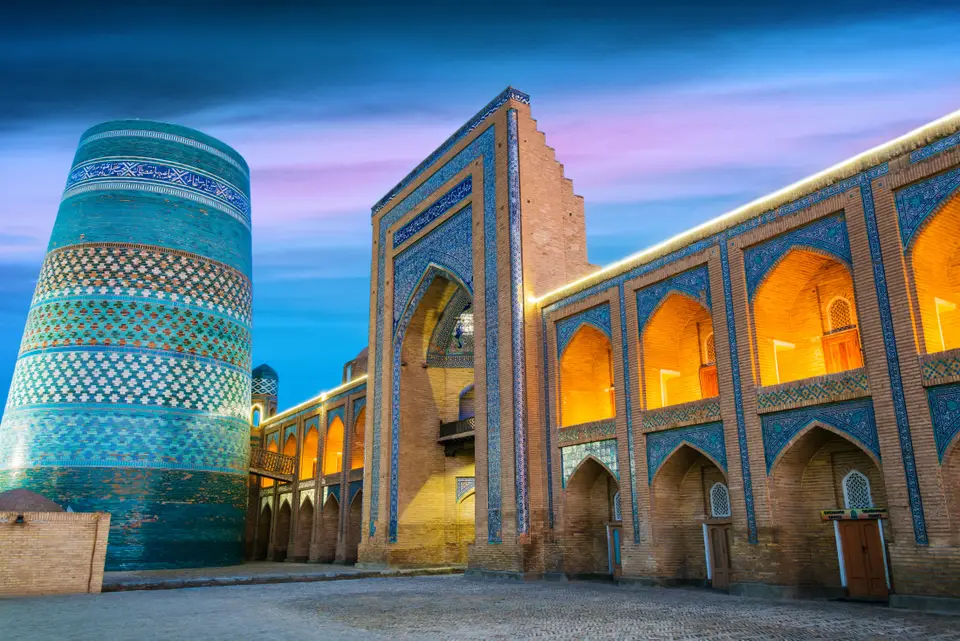
Kalta Minor (“short minaret”) is the symbol of Khiva: a wide, stubby tower about 29 metres high, entirely covered in turquoise, blue and white glazed tiles. Begun around 1851 by Muhammad Amin Khan, it was meant to be the tallest minaret in Central Asia but was abandoned in 1855, when the khan was killed in battle.
The minaret that was never finished
Muhammad Amin Khan, who ruled Khiva from 1845 to 1855, was an ambitious ruler who strengthened the khanate and built on a grand scale. Next to his new madrasah, the largest in the city, he ordered a minaret that would surpass all others. Its base, about 14 metres across, shows the scale he intended: had it been completed, it might have reached 70–80 metres, higher than the Kalyan minaret of Bukhara.
In 1855 the khan led a campaign against the Turkmen tribes and was killed near Sarakhs. Work stopped and never resumed. The tower remained at around 29 metres, a broad, slightly tapering stump with a flat top, which gives it its unusual, almost barrel-like silhouette.
The legends
Khivans tell other stories. In one, the khan wanted the minaret to be so tall that he could see Bukhara from the top, and the emir of Bukhara, learning of the plan, bribed the architect to build an even taller minaret for him instead. The khan discovered the plot, and the architect fled, or was executed, leaving the tower unfinished. In another version, people objected that from the top of such a tower a muezzin could look into the courtyards of their houses and see their women. These stories are much repeated to visitors; historians prefer the simpler explanation of the khan’s death.
A tower dressed in tiles
What makes Kalta Minor unique is that it is covered from base to top in glazed tiles and glazed brick, with no bare brick showing, unlike almost all earlier minarets in Central Asia. Horizontal bands of different patterns alternate around the tower: turquoise and blue geometric designs, white glazed brick, rows of majolica tiles with floral motifs, and bands of inscriptions. The colours, dominated by turquoise and deep blue, glow in the sun against the beige mud-brick of the surrounding city.
The decoration is typical of 19th-century Khiva, when local tile makers produced brilliant majolica in blue, white and turquoise with fine floral patterns. You can see similar work on the Tash-Hauli palace and the Kunya Ark.
Inside, a staircase was built as the tower rose, but the minaret is not open for climbing.
Where it stands
Kalta Minor stands just inside the Ata Darvaza, the western gate and main entrance of Ichan-Kala, next to the Muhammad Amin Khan madrasah, from which it was meant to rise. Opposite is the Kunya Ark, the old fortress of the khans. It is the first great monument most visitors see on entering the old city, and the view of the minaret framed by the gate and the madrasah portal is one of the classic images of Central Asia.
Photographing Kalta Minor
- Morning: the eastern face catches the sun; the square in front of the madrasah is quiet.
- Late afternoon and sunset: the low sun lights the western side and the tiles turn rich and warm. This is the most popular time.
- Blue hour and night: the minaret is lit after dark, and the tiles glow against the sky.
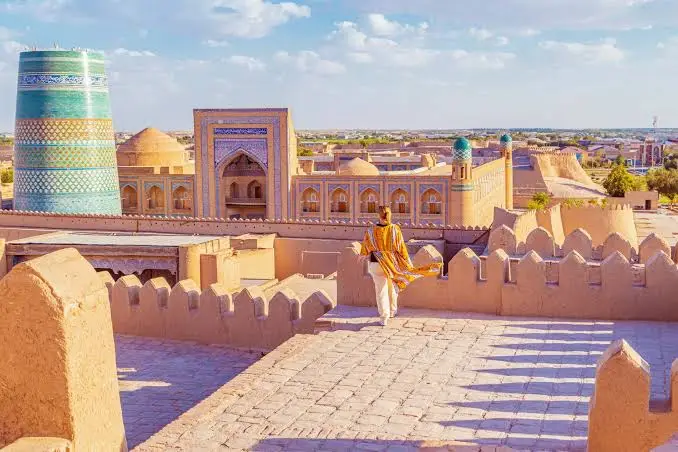
- From above: the best overall view is from the watchtower of the Kunya Ark or from the city walls, where Kalta Minor rises above the flat roofs and domes with the Islam Khoja minaret in the background.
- From the street leading east: looking back west along the main street, the minaret fills the end of the view.
Visiting
Location: just inside the western gate of Ichan-Kala.
Tickets: the minaret is seen from the outside, which costs nothing beyond the Ichan-Kala entry ticket needed to enter most monuments. Check current rules at the gate.
Time needed: 10–15 minutes, plus photographs at different times of day.
Nearby: the Kunya Ark, the Muhammad Amin Khan madrasah and the gates of Khiva. See also our Khiva itinerary.
Frequently asked questions
Why is Kalta Minor unfinished?
Work stopped in 1855 when its builder, Muhammad Amin Khan, was killed in battle. Legends about an architect who fled to Bukhara are popular but unproven.
How tall is Kalta Minor?
About 29 metres, with a base around 14 metres in diameter. It was planned to be much taller.
Can you climb Kalta Minor?
No. It is not open for climbing; for a view over Khiva, climb the Islam Khoja minaret or the Kunya Ark watchtower.
Rules, timetables and prices change. We check this page regularly, but always confirm entry requirements with official sources before you travel.