Khiva · Sights
The gates and walls of Khiva
The mud-brick walls of Ichan-Kala and its four gates, Ata, Bagcha, Palvan and Tash Darvaza, their history and stories, walking on the walls and the outer walls of Dishan-Kala.
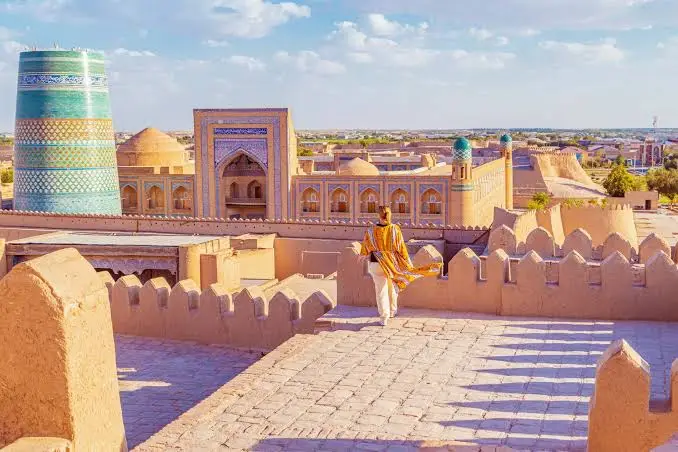
Ichan-Kala, the inner town of Khiva, is enclosed by mud-brick walls about 2.2 km long and up to 10 metres high, with four gates: Ata Darvaza (west), Bagcha Darvaza (north), Palvan Darvaza (east) and Tash Darvaza (south). A stretch of wall can be walked for views over the city, best at sunset.
A walled city in the desert
Khiva lies in the oasis of Khorezm, between the Karakum and Kyzylkum deserts. For centuries it was exposed to raids by nomads, and like every town in the region it was protected by walls. The present walls of Ichan-Kala date mostly from the 17th–18th centuries and were repeatedly repaired; some sections and towers were rebuilt in the 20th century. Archaeologists have found that the walls stand on much older foundations.
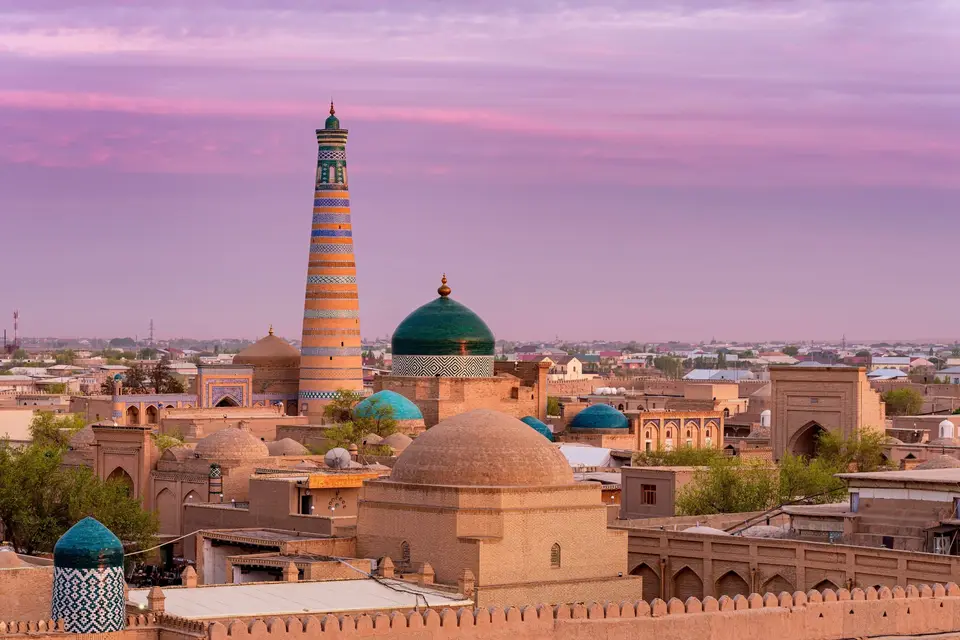
The walls are built of sun-dried mud brick, wider at the base (up to about 6–8 metres) than at the top, with rounded towers projecting at regular intervals and battlements with loopholes for archers and later for guns. Their smooth, sloping, sand-coloured surfaces give Khiva its distinctive appearance, especially in the low light of sunrise and sunset. The whole of Ichan-Kala, walls included, was listed as a UNESCO World Heritage Site in 1990.
Outside, Khiva had a second, outer wall around Dishan-Kala, the outer town, built in the 1840s under Allakuli Khan. It was about 6 km long with ten gates; parts survive, including some gates.
Ata Darvaza (west gate)
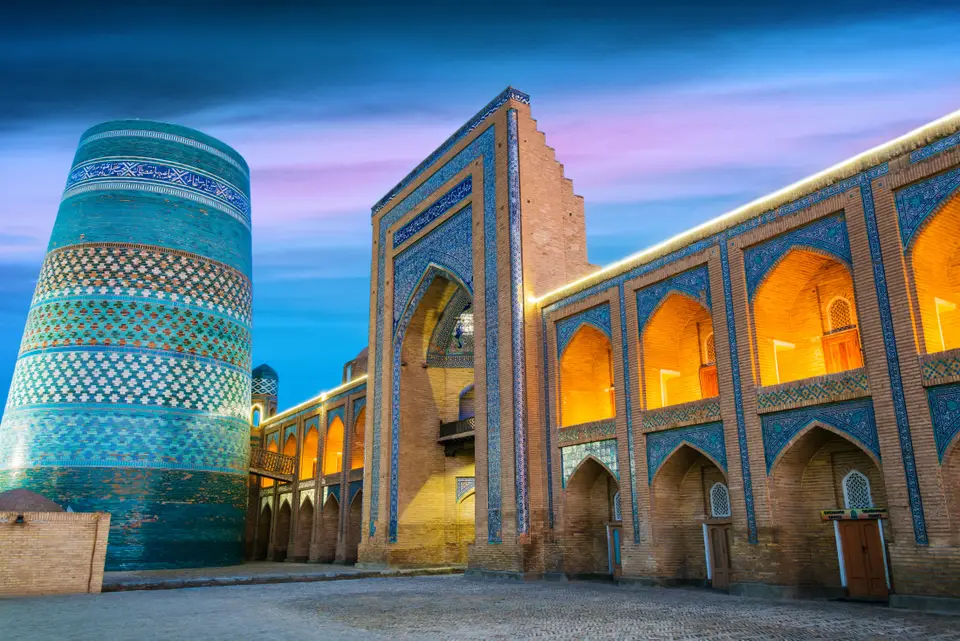
The Ata Darvaza (“father gate”) is the main entrance for visitors. The original gate was demolished in the Soviet period, and the present gate with its twin towers and gallery was rebuilt in the 1970s. Outside it, a statue honours al-Khwarizmi, the 9th-century mathematician from Khorezm whose name gave us the word “algorithm”. Inside are the ticket office, Kalta Minor, the Muhammad Amin Khan madrasah and the Kunya Ark.
Bagcha Darvaza (north gate)
The Bagcha Darvaza (“garden gate”) faced the gardens and fields to the north of the city and the road towards Urgench. Near it, a section of the wall is usually open to visitors: steps lead up to the top, and you can walk along the battlements for some distance, looking over the roofs of Ichan-Kala on one side and the modern town on the other. This is one of the best places to watch the sunset in Khiva.
Palvan Darvaza (east gate)
The Palvan Darvaza (“gate of the champion”), named after the nearby shrine of the city’s patron saint, is the most interesting gate. Its long vaulted passage, with small domed niches along the sides, leads to the bazaar outside the walls. It was also known as the gate of the slaves: in the 19th century, Khiva was the largest slave market in Central Asia, and captives, many of them Persians and Russians seized by Turkmen raiders, were sold here. Criminals were punished and executed nearby. The Russian conquest of 1873 ended the slave trade. Next to the gate are the Allakuli Khan madrasah, the caravanserai and the covered market.
Tash Darvaza (south gate)
The Tash Darvaza (“stone gate”) faced the road to the south, towards the Karakum desert and Merv. Its towers are decorated with glazed bricks. It is the quietest of the four gates and gives access to the residential southern lanes of Ichan-Kala, a good place to see everyday life behind the monuments.
Walking on and around the walls
- On top: the section near the north gate is usually open, with a small ticket. Allow 30–45 minutes, and wear good shoes; the surface is uneven and has no railings in places.
- Around the outside: a walk around the outside of the walls takes about an hour and shows how massive they are. Near the west gate, the slopes are pitted with old burial niches, since the walls were also used as a cemetery.
- Viewpoints: besides the walls, the best views are from the Kunya Ark watchtower and the top of the Islam Khoja minaret.
Visiting
Tickets: the gates are free to pass; the Ichan-Kala combined ticket is bought at the west gate. Walking on the wall may require a separate ticket.
Best time: sunrise and sunset, when the mud brick glows golden; the evening is also when locals stroll around the walls.
See also: the Nurullaboy palace just outside the walls, the Tash-Hauli palace near the east gate, and our Khiva itinerary.
Frequently asked questions
How many gates does Ichan-Kala have?
There are four, Ata Darvaza (west), Bagcha Darvaza (north), Palvan Darvaza (east) and Tash Darvaza (south).
Can you walk on the walls of Khiva?
Yes, a section near the north gate is usually open, with a small ticket. It is a great place to watch the sunset.
How long are the walls of Khiva?
The walls of Ichan-Kala are about 2.2 km long and up to 10 metres high.
Rules, timetables and prices change. We check this page regularly, but always confirm entry requirements with official sources before you travel.