Samarkand · Sights
Mausoleum of Imam al-Maturidi
The tomb of the 10th-century Samarkand theologian whose school of belief is followed by much of the Sunni Muslim world.
The mausoleum of Abu Mansur al-Maturidi (died 944) stands in the historic Chokardiza cemetery in Samarkand. Al-Maturidi founded one of the two main schools of Sunni theology, followed today by most Hanafi Muslims from Turkey to India and Central Asia. The present mausoleum was rebuilt around 2000. A visit takes 20–30 minutes.
Who was al-Maturidi
Abu Mansur Muhammad al-Maturidi was born in Maturid, a quarter of Samarkand, in the late 9th century and spent his life in the city as a teacher and writer. He lived under the Samanid dynasty, when Samarkand and Bukhara were centres of Islamic scholarship.
His most important work, the Kitab al-Tawhid (“Book of Monotheism”), set out a systematic theology that balanced reason and revelation. Al-Maturidi argued that human reason can recognise the existence of God and the difference between good and evil, while revelation completes that knowledge. He also wrote a large commentary on the Quran. His approach became the basis of the Maturidi school of Sunni theology, alongside the Ash’ari school founded by his contemporary in Iraq.
Why he matters today
The Maturidi school is the main theological tradition for the Hanafi Muslims of Central Asia, Turkey, the Balkans, the Caucasus, Afghanistan, Pakistan and India, hundreds of millions of people. In Uzbekistan al-Maturidi is honoured as one of the great scholars of the country’s past, together with al-Bukhari, al-Tirmidhi and Bahauddin Naqshband, and his name is used for scholarly institutions and conferences. For many Muslim visitors, praying at his tomb is an important part of a pilgrimage to Samarkand.
The mausoleum and cemetery
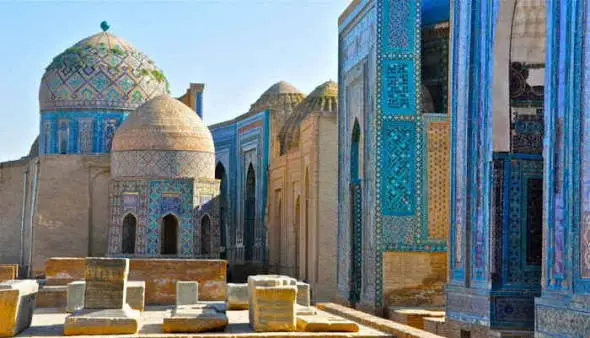
Al-Maturidi was buried in the Chokardiza cemetery, once the burial ground of many scholars of Samarkand. Over the centuries the cemetery was built over and the original tomb disappeared. Around 2000 a new mausoleum was built on the traditional site: a domed building with tiled portals and an open lattice structure around the grave, set in a landscaped courtyard. Several other graves of scholars are marked in the surroundings.
The architecture is modern, but the setting is calm and the site is cared for. You will often see small groups of pilgrims reciting prayers.
Visiting
The mausoleum is in the northern part of the old city, a short taxi ride from the Registan or Gur-Emir. Entry has usually been free. Dress modestly: women should cover hair, shoulders and knees; men should wear long trousers. Behave as at any holy site and ask before taking photographs of people.
It combines naturally with the other sites associated with Samarkand’s religious scholars: the Imam al-Bukhari complex in Hartang, 25 km north, and the Khoja Akhrar complex in the south of the city. A guide familiar with Islamic history makes such a half-day far more meaningful.
Samarkand’s scholars
Between the 9th and 12th centuries the cities of Transoxiana, the land between the Amu Darya and Syr Darya rivers, produced an extraordinary number of scholars in law, theology, hadith and science. Al-Maturidi in Samarkand, al-Bukhari and later Bahauddin Naqshband near Bukhara, al-Tirmidhi near Termez and the polymaths al-Khwarizmi and al-Biruni from Khorezm all belong to this tradition. Visiting their tombs is a way of understanding why Central Asia sees itself as one of the cradles of Islamic civilisation.
Maturidi teaching in brief
Al-Maturidi’s theology is often described as a middle path. Against those who relied only on literal readings of scripture, he defended the role of reason in understanding faith; against philosophers who relied only on reason, he insisted on the authority of revelation. He held that faith is belief in the heart affirmed by the tongue, and that human beings are responsible for their actions while God remains all-powerful. These positions shaped the religious education of Central Asian madrasahs for a thousand years, including those you visit in Samarkand and Bukhara, and they remain central to Hanafi Islam today.
Frequently asked questions
Who was Imam al-Maturidi?
A 10th-century theologian from Samarkand (died 944) who founded the Maturidi school of Sunni theology, followed by most Hanafi Muslims.
Is the mausoleum old?
The grave is old, but the original tomb was lost; the present mausoleum was built around 2000 on the traditional site.
Do I need a ticket?
Entry has usually been free. Dress modestly and behave respectfully.
Rules, timetables and prices change. We check this page regularly, but always confirm entry requirements with official sources before you travel.