Culture & etiquette
Al-Khwarizmi, the father of algebra
The life and work of Muhammad ibn Musa al-Khwarizmi, the 9th-century scholar from Khorezm whose book gave us the word algebra and whose name gave us the word algorithm, his work in Baghdad, his influence on Europe, and where to see his memory in Khiva and Urgench.
Muhammad ibn Musa al-Khwarizmi (c. 780–c. 850) was a mathematician, astronomer and geographer from Khorezm, the region of Khiva. Working in Baghdad, he wrote the book that gave us the word algebra, and his own name became the word algorithm. A statue of him stands outside the west gate of Khiva.
A scholar from Khorezm
Al-Khwarizmi’s name means "the man from Khwarazm", the ancient oasis of Khorezm on the lower Amu Darya, where Khiva and Urgench stand today. Little is known about his early life. He was born around 780, probably in Khorezm, possibly in or near Khiva, as local tradition holds. Khorezm was then a prosperous land with a long scientific tradition: the great scholar al-Biruni was born there two centuries later.
The House of Wisdom in Baghdad
Al-Khwarizmi moved to Baghdad, the capital of the Abbasid caliphate, where he worked at the House of Wisdom (Bayt al-Hikma) under the caliph al-Ma’mun. This was a centre of translation and research, where scholars translated Greek, Persian and Indian works into Arabic and developed them further. Al-Khwarizmi worked on mathematics, astronomy and geography, and took part in measuring the Earth.
Algebra
His most famous work is al-Kitab al-mukhtasar fi hisab al-jabr wa’l-muqabala, "The compendious book on calculation by completion and balancing", written around 820. It explained systematically how to solve linear and quadratic equations, with practical examples from trade, inheritance and land measurement. The word al-jabr in the title, meaning "restoration" or "completion", became our word algebra.
The book was translated into Latin in the 12th century and became one of the foundations of mathematics in medieval Europe.
Numbers and algorithms
Another book by al-Khwarizmi explained the Indian system of numerals, with nine digits and zero, and how to calculate with them. Through Latin translations, it helped spread the Hindu-Arabic numerals we use today across Europe. In these translations, his name was written as Algoritmi, and the methods of calculation he described became known as algorisms, the origin of the modern word algorithm, now central to computing.
Astronomy and geography
Al-Khwarizmi also wrote astronomical tables (zij) based on Indian and Persian methods, which were used for centuries, and a work on geography, Kitab surat al-ard ("The book of the image of the Earth"), listing the coordinates of hundreds of cities, mountains and rivers, improving on the work of Ptolemy. He wrote about the Jewish calendar, the astrolabe and sundials.
Why he still matters
Every time you use a search engine, a navigation app or a computer, you rely on algorithms, step-by-step procedures named after al-Khwarizmi. School algebra, from solving for x to quadratic equations, follows the path he set out twelve centuries ago. Historians of science debate how original each of his methods was, since he drew on Babylonian, Greek and Indian traditions, but they agree that his clear, systematic books shaped how mathematics was taught for centuries, first in the Islamic world and then in Europe. For the people of Khorezm, he is a source of great pride.
His memory in Khiva and Urgench
In Khiva, a large statue of al-Khwarizmi, seated with a book, stands just outside the western gate of Ichan-Kala, near the start of most visits. It is a popular meeting point and photo spot. In Urgench, the regional capital, a university and a monument bear his name. In 1983, the Soviet Union celebrated the 1,200th anniversary of his birth, and a stamp was issued in his honour.
Khorezm is proud of its scholars: besides al-Khwarizmi, it was home to al-Biruni and, in the 11th century, the Mamun Academy of Gurganj, where Ibn Sina also worked for a time. See Ibn Sina.
Visiting Khiva
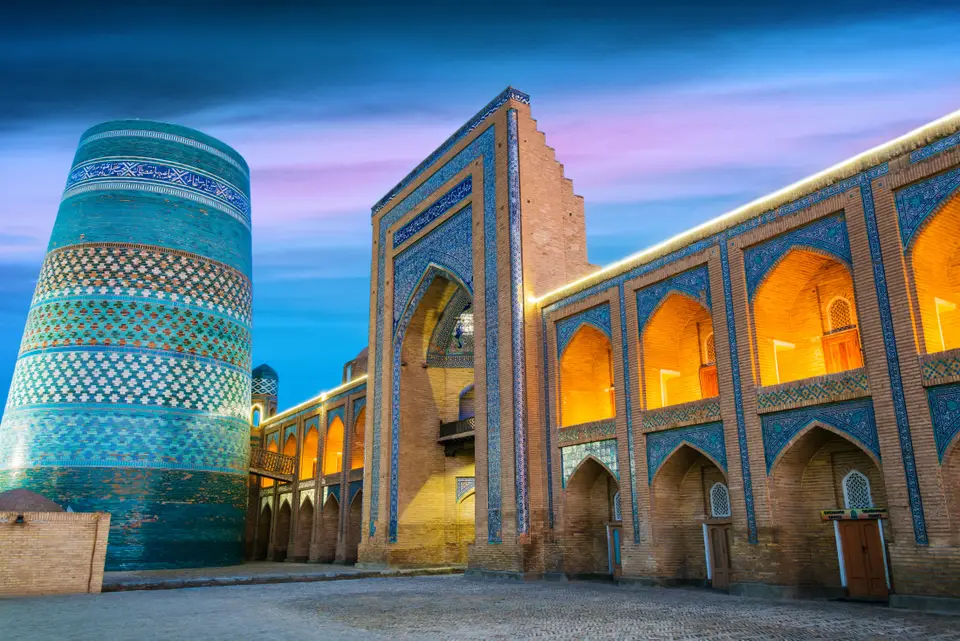
Start your visit to Khiva at the al-Khwarizmi statue, then enter Ichan-Kala through the western gate to see the Kalta Minor minaret, the Kunya-Ark and the Juma mosque. See our Khiva itinerary and how to get to Khiva. Our team is based in Khiva and can arrange guides who tell the story of Khorezm’s scholars.
Frequently asked questions
Who was al-Khwarizmi?
A 9th-century mathematician, astronomer and geographer from Khorezm, who worked in Baghdad and gave his name to the word algorithm.
Why is al-Khwarizmi called the father of algebra?
His book on al-jabr explained systematically how to solve equations, and its title gave us the word algebra.
Where is the al-Khwarizmi statue?
Outside the western gate of Ichan-Kala in Khiva.
Rules, timetables and prices change. We check this page regularly, but always confirm entry requirements with official sources before you travel.