Bukhara · Sights
Modari Khan and Abdullah Khan madrasahs: the Kosh Madrasah
The paired Modari Khan and Abdullah Khan madrasahs in the south-west of Bukhara’s old city, built by Abdullah Khan II for his mother and himself, their history and architecture.
The Kosh Madrasah (“double madrasah”) is a pair of facing madrasahs in the south-west of Bukhara’s old city. The Modari Khan madrasah (1566–1567) was built by the future ruler Abdullah Khan II in honour of his mother; the larger Abdullah Khan madrasah (1588–1590) faces it across the street. Away from the main tourist routes, they are quiet and atmospheric. Allow 20–30 minutes.
Abdullah Khan II and his mother
Abdullah Khan II (1534–1598) was the most powerful ruler of the Shaybanid dynasty. He governed first in the name of his father and from 1583 as khan in his own right, uniting a large part of Central Asia under Bukhara. He was also one of the city’s greatest builders: the covered bazaars of the trading domes, caravanserais, baths, bridges and many madrasahs date from his time.
In 1566–1567 he built a madrasah dedicated to his mother, known as Modari Khan, “the Khan’s mother”. Two decades later, as reigning khan, he built a second, larger madrasah directly opposite it in his own name. Together they form a kosh, a pair of facing buildings, a favourite arrangement in Bukharan town planning, also seen at Poi Kalyan and in the Ulugbek and Abdulaziz Khan madrasahs.
The Modari Khan madrasah
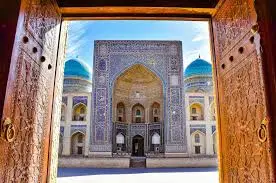
The older and smaller of the two, Modari Khan is a compact courtyard madrasah with student cells on two floors. Its portal is decorated with tile mosaic in blue and white, with geometric patterns and an inscription giving the date of construction. It is simpler than later buildings but well proportioned. It has long been used as a residence or for other purposes and may not be open inside.
The Abdullah Khan madrasah
The Abdullah Khan madrasah is the larger and more ambitious building. Its high portal is decorated with tile mosaic and carved glazed brick, and the facade is flanked by wings with arched niches. Inside, its plan is unusual: besides the usual courtyard and cells, it has complex vaulted halls and corridors, with domed rooms arranged in an intricate way that shows the skill of 16th-century Bukharan builders in vaulting. The interior has been restored, and the madrasah has housed craft workshops and exhibitions.
The contrast between the two portals, the modest one of the mother and the grand one of the son, makes a fine comparison.
Madrasahs and their endowments
In 16th-century Bukhara a madrasah was more than a building: it was an institution financed by a waqf, a perpetual religious endowment. When Abdullah Khan founded these schools, he assigned to them the income of shops, caravanserais, baths, mills and farmland. The revenue paid the teachers, gave students a small stipend and bread, and covered repairs. The endowment deeds, written on long scrolls, set out exactly how many students could live there and what they would study. Many of these deeds survive and are a major source for the economic history of the city. Building a madrasah in the name of one’s mother was both an act of filial piety and a way of earning religious merit for her, and it placed the dynasty’s name permanently in the life of the city.
A quieter Bukhara
The Kosh Madrasah stands in the south-west of the old city, in an area few visitors reach. Around it are residential lanes, small mosques and old houses. Walking here gives a sense of everyday life in Bukhara away from the shops of the centre. Nearby is the Fayzulla Khodjaev house, the merchant mansion of the family of an early Soviet leader. Fragments of the old mud-brick city walls survive in several places on the western edge of the old city.
Visiting
Location: in the south-western part of the old city, about 15 minutes’ walk south-west of Poi Kalyan and 10 minutes from the Samanid mausoleum.
Tickets: the exteriors are free; a small fee may be charged for the Abdullah Khan madrasah’s interior and workshops.
Time needed: 20–30 minutes.
Tips: combine with the Fayzulla Khodjaev house in a walk through the quieter south-west of the old city. The portals face each other across a narrow street, so a wide-angle lens helps.
Frequently asked questions
What is the Kosh Madrasah in Bukhara?
The pair of facing madrasahs, Modari Khan (1566–1567) and Abdullah Khan (1588–1590), both built by the Shaybanid ruler Abdullah Khan II.
Who was the Modari Khan madrasah built for?
Abdullah Khan II built it in honour of his mother; Modari Khan means “the Khan’s mother”.
Are the madrasahs open to visitors?
The exteriors can always be seen. The Abdullah Khan madrasah is usually open inside with workshops; Modari Khan may be closed.
Rules, timetables and prices change. We check this page regularly, but always confirm entry requirements with official sources before you travel.