Bukhara · Sights
Namazgokh Mosque, Bukhara
The Namazgokh, Bukhara’s 12th-century open-air festival mosque outside the old city, what a namazgokh was, its carved brick wall and how to combine it with other sights.
The Namazgokh is an open-air festival mosque built in the 12th century outside the walls of Bukhara, where the whole male population of the city gathered for prayers on the two great Muslim holidays, Eid al-Fitr and Eid al-Adha. What survives is mainly a monumental brick qibla wall with a niche, decorated with carved brick and terracotta. It is little visited and best for travellers with a special interest in architecture.
What is a namazgokh?
Namazgokh (or namazgah) means “place of prayer”. In medieval Central Asian cities, the Friday mosque could not hold the entire population on the two most important holidays of the year, the festival at the end of Ramadan (Eid al-Fitr, Uzbek Ramazon hayiti) and the Feast of Sacrifice (Eid al-Adha, Qurbon hayiti). For these occasions, cities built a large open space outside the walls, with a wall facing Mecca (the qibla wall) and a niche (mihrab) to show the direction of prayer. Tens of thousands could gather there, led by the ruler and the chief imam.
Bukhara’s namazgokh was built in 1119–1120 by the Karakhanid ruler Arslan Khan, the same ruler who built the Kalyan minaret. The site had been used for festival prayers since earlier times. In later centuries the building was repaired and extended, notably in the 14th and 16th centuries, when side arches and domed rooms were added.
The building
The core of the monument is the qibla wall with a deep niche in the middle, framed by a tall arch. The original 12th-century work is visible in the carved brick and terracotta decoration of the mihrab: geometric patterns, interlacing bands, rosettes and inscriptions in Kufic script, very similar in style to the decoration of the Kalyan minaret and the facade of the Magoki-Attori mosque. The fine carving shows the high level of the Karakhanid brickwork.
Later additions are visible in the different brick and the tile decoration of the arches on each side. In front of the wall stretches the open space, once the prayer ground for the crowds, now partly landscaped. The building has served as a mosque again since independence.
Karakhanid Bukhara
The Namazgokh is one of only a handful of buildings that survive from the Karakhanid period (11th–12th centuries), along with the Kalyan minaret and the facade of the Magoki-Attori mosque. The Karakhanids were a Turkic dynasty who took Bukhara from the Samanids at the end of the 10th century and ruled until the arrival of the Khwarazmshahs and the Mongols. Their buildings are notable for their extraordinary brickwork, the last great achievement of Central Asian architecture before the Mongol conquest of 1220. Seeing these three monuments together gives a picture of a Bukhara that has otherwise vanished.
Visiting
Location: outside the historic centre, to the south-east of the old city. It is easiest to reach by taxi, about 10 minutes from Lyabi-Hauz.
Tickets: generally free; it is a place of worship, so visit outside prayer times.
Time needed: 20–30 minutes.
Etiquette: dress modestly and remove shoes where required.
When to go: on Eid mornings the mosque is again filled with worshippers, a remarkable sight if you are in Bukhara at the right time, though as a visitor you should watch respectfully from a distance. On other days it is quiet, and you may have the site to yourself. Morning or late afternoon light brings out the relief of the carved brick.
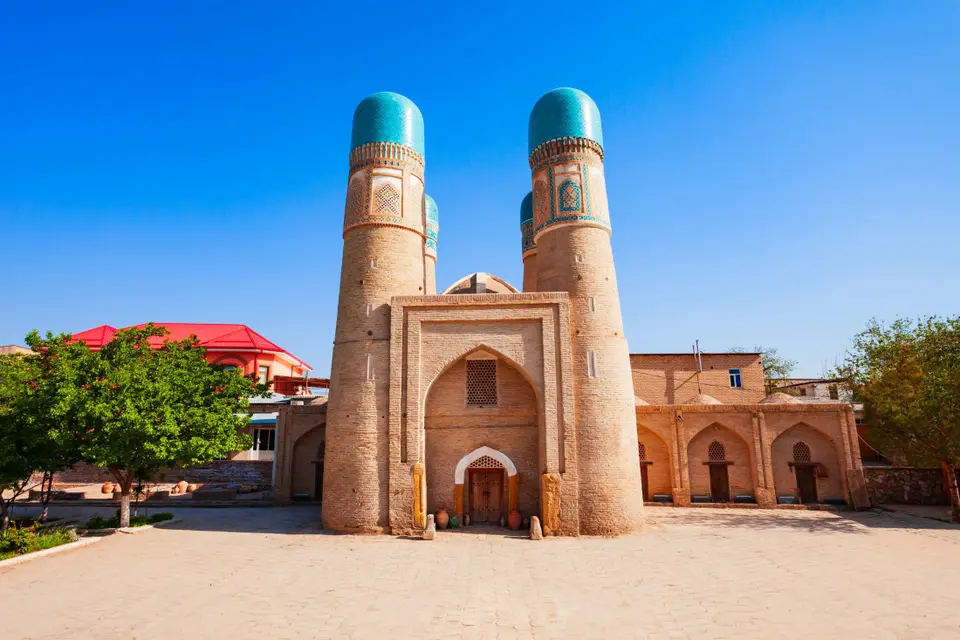
Is it worth it? For most first-time visitors with two days in Bukhara, the monuments of the old city come first. If you have a third day or a strong interest in Islamic architecture, the Namazgokh is a rewarding addition, especially combined with the Chor Minor and a drive to Sitorai Mohi-Hosa.
Frequently asked questions
What is the Namazgokh mosque?
An open-air festival mosque built in 1119–1120 outside the walls of Bukhara for the mass prayers of Eid al-Fitr and Eid al-Adha.
Who built the Namazgokh?
The Karakhanid ruler Arslan Khan, who also built the Kalyan minaret.
Is the Namazgokh worth visiting?
For travellers interested in architecture, yes, especially for its 12th-century carved brick mihrab. Others may prefer to focus on the old city.
Rules, timetables and prices change. We check this page regularly, but always confirm entry requirements with official sources before you travel.