Nukus · Sights
Chilpik tower of silence
Chilpik, a ring-shaped Zoroastrian tower of silence on a hill above the Amu Darya between Nukus and Khiva, where the dead were once exposed to the elements, its history, the view and how to visit.
Chilpik is a ring-shaped mud-brick enclosure on top of a hill above the Amu Darya, about 40 km south of Nukus on the road to Khiva. It is believed to have been a Zoroastrian dakhma or "tower of silence", where the dead were exposed so birds could clean the bones. The climb takes about 15 minutes.
A ring on a hill
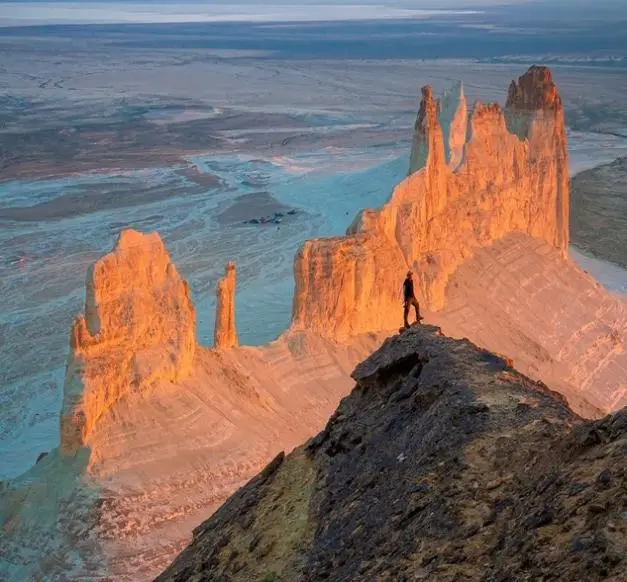
Driving between Khiva and Nukus, on the right bank of the Amu Darya, you see a strange shape on the skyline: a steep, isolated hill crowned by a round wall. This is Chilpik (Shilpyk in Karakalpak), one of the most atmospheric ancient monuments of Karakalpakstan.
The hill rises some 35–40 metres above the plain. On its flat top, a roughly circular wall of mud brick and rammed earth encloses an open space about 65 metres across. The walls, eroded by wind and rain, still reach a height of several metres in places.
What was a tower of silence?
Before the arrival of Islam, the main religion of ancient Khorezm was Zoroastrianism, one of the oldest faiths in the world. Zoroastrians considered earth, fire and water sacred and did not want them polluted by dead bodies. Instead of burying or burning the dead, they placed them in high, open enclosures, called dakhmas or "towers of silence", where vultures and the sun cleaned the bones.
The bones were then collected and placed in ossuaries, clay boxes often decorated with figures, which were buried or kept in family tombs. Ossuaries from Khorezm can be seen in the Savitsky Museum in Nukus.
The history of Chilpik
Archaeologists date the use of Chilpik to roughly the 1st century BC to the 4th century AD, possibly later, when Khorezm was a powerful kingdom with fortresses such as Toprak Kala. Its position on a lonely hill, visible from far away and exposed to the wind, fits the Zoroastrian rules for a dakhma. Some researchers have suggested other uses, such as a fortress or a signal post, as the site has not been fully excavated; but the tower of silence remains the most widely accepted interpretation.
Later, after the Islamic conquest, the site was abandoned. In the Middle Ages, local people may have used it as a watchtower over the river crossing.
The climb and the view
A steep path leads up the side of the hill from the road. The climb takes 10–15 minutes and the ground is loose and sandy in places, so wear good shoes. At the top you can walk around the inside of the ring and look out through gaps in the walls.
The view is the main reward: the wide brown ribbon of the Amu Darya, the green irrigated fields on one side and the desert on the other, and in the distance, on a clear day, the Sultan Uvays hills. At sunset the walls glow and the landscape turns gold.
Visiting
Location: beside the main road between Nukus and Khiva (via Beruni), about 40 km south of Nukus.
Tickets: there is usually no ticket office; the site is open.
Time needed: 30–45 minutes, including the climb.
Tips: there is no shade or water at the site; bring water, a hat and sunscreen. Avoid the climb in the midday heat of summer. In wet weather the slope can be slippery. Climb only on the existing path and do not dig or take anything from the site.
Combining Chilpik with other sites
Chilpik is an easy stop on a day trip between Khiva and Nukus. A popular route leaves Khiva in the morning, visits the desert fortresses of Kyzyl Kala, Toprak Kala and Ayaz Kala, then continues north past Chilpik to Nukus for the Savitsky Museum and the Mizdakhan necropolis. We arrange cars with drivers and guides for this route from our office in Khiva.
Frequently asked questions
What is Chilpik?
A ring-shaped ancient enclosure on a hill above the Amu Darya, believed to be a Zoroastrian dakhma (tower of silence) where the dead were exposed.
How old is Chilpik?
It is usually dated to between the 1st century BC and the 4th century AD.
Where is Chilpik?
Beside the Nukus–Khiva road, about 40 km south of Nukus, on the right bank of the Amu Darya.
Rules, timetables and prices change. We check this page regularly, but always confirm entry requirements with official sources before you travel.