Blog · photography, Samarkand
The best photography spots in Uzbekistan, and when to shoot them
The most photogenic places in Uzbekistan, from the Registan at blue hour and the tiled lanes of Shah-i-Zinda to Bukhara’s Kalyan minaret, Khiva’s walls at sunset, the desert fortresses, the Aral Sea and the Tashkent metro, with the best times, angles and practical tips.
Uzbekistan is a dream for photographers. Top spots include the Registan at sunrise and blue hour, the tiled street of Shah-i-Zinda in soft morning light, Bukhara’s Kalyan minaret from a rooftop at sunset, Khiva’s walls and minarets at golden hour, the desert fortresses, and the rusting ships of Muynak. Shoot early and late to avoid harsh light and crowds.
Light in Uzbekistan
Uzbekistan’s dry climate means clear skies most of the year and strong, hard light in the middle of the day, especially in summer. The best photographs are taken in the first two hours after sunrise and the last two hours before sunset, when the tiles glow, the shadows are long and the crowds are thinner. Blue hour, just after sunset, is magical at illuminated monuments. Spring and autumn give the softest light and the most comfortable conditions.
Samarkand
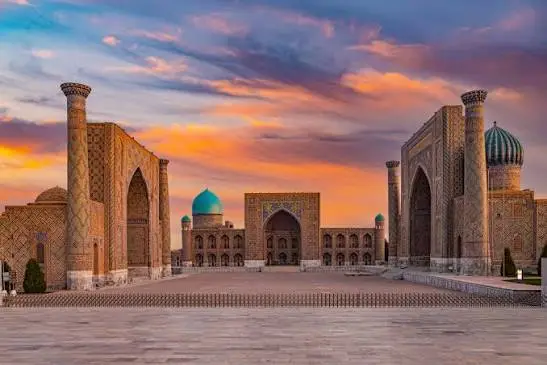
- The Registan: shoot the three madrasahs from the viewing platform at sunrise, when the square is empty, and at blue hour, when they are lit. Inside the madrasahs, the courtyards and tiled portals offer many details.
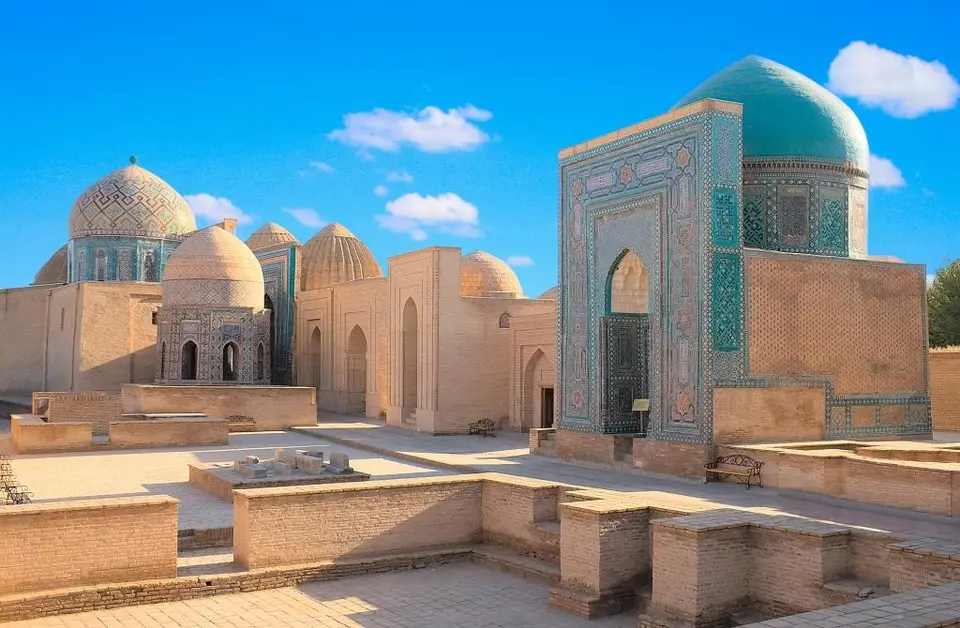
- Shah-i-Zinda: the narrow street of mausoleums is best in the early morning, when the light is soft and the turquoise tiles shine. Go at opening time to avoid people in the frame. See Shah-i-Zinda.
- Gur-Emir: the ribbed dome at sunset, and the golden interior.
- Bibi-Khanym: the giant portal and dome from the Siab bazaar side; the bazaar itself offers wonderful portraits and colours.
- Registan at night: some evenings feature light shows.
Bukhara
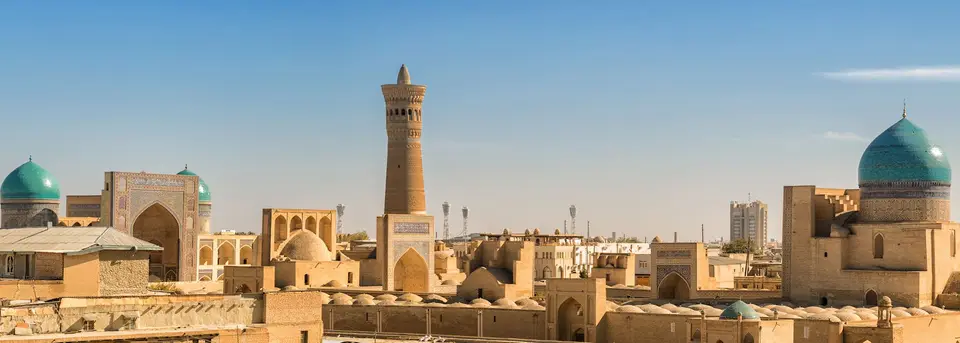
- Kalyan minaret and Poi-Kalyan: the classic view at sunset from a rooftop café or terrace overlooking the square; also from inside the courtyard of the Kalyan mosque.
- Lyabi-Hauz: reflections in the pool at dusk, with mulberry trees and madrasahs.
- Chor Minor: the four turquoise-capped towers in morning light.
- The trading domes: craftsmen at work, metalwork, carpets and textiles in soft indoor light.
- The Ark: its sloping walls at golden hour.
Khiva
Khiva is perhaps the most photogenic city in Uzbekistan, because it is complete and compact.
- The walls at sunset: climb the walls near the northern gate, or the watchtower of the Kunya-Ark, for a view over domes and minarets turning gold.
- Kalta Minor: the turquoise, unfinished minaret, best in morning or late afternoon light. See Kalta Minor.
- Islam Khodja minaret: climb it for a panoramic view, or shoot it framed by lanes.
- Juma mosque: the forest of carved wooden columns, lit by shafts of light from the roof.
- Empty lanes at dawn, when Ichan-Kala is silent.
See Khiva sunset spots and our Khiva itinerary.
The desert and the Aral Sea
- Desert fortresses: Ayaz Kala at sunset, with the desert and Lake Akchakul behind; Toprak Kala in low side light that reveals the shapes of the walls.
- Yurt camps: campfires, camels and the night sky; the Milky Way is visible far from cities.
- Muynak: rusting ships on the dry seabed, especially at sunset. See Muynak ship cemetery.
- Ustyurt cliffs: the white escarpments above the Aral Sea at golden hour. See Ustyurt Plateau.
Tashkent and the mountains
- The metro: many stations are works of art; photography has been allowed in recent years. Kosmonavtlar, Alisher Navoi and Tashkent stations are favourites.
- Chorsu bazaar: the great dome from above and portraits of traders.
- Khast Imam: the mosque and madrasahs, best in the morning.
- Charvak and Chimgan: turquoise water and mountains, especially in spring and autumn. See Charvak reservoir.
People and portraits
Uzbeks are often happy to be photographed, and many will ask you to take their picture. Always ask first, with a smile and a gesture; respect a refusal, especially from women and older people. Bazaars, teahouses, craft workshops and weddings at the monuments are wonderful for portraits. Offering to send the photo, or showing it on your screen, is appreciated.
Practical tips
- Tickets: some monuments charge an extra fee for photography or video; keep small change.
- Drones require permission and can be confiscated at the border without it.
- Tripods may be restricted at some sites; ask first.
- Restricted places: do not photograph border posts, military sites, police or some government buildings.
- Dust: in the desert, protect your gear from sand and change lenses carefully.
- Seasons: spring blossom and autumn colours are especially beautiful; see when to go.
See also our guide to photography tips in Central Asia.
A photographer’s route
A route designed for light and timing: Tashkent (metro, Chorsu) → Samarkand (sunrise at the Registan, morning at Shah-i-Zinda, blue hour at the Registan) → Nuratau and Aydarkul (village portraits, desert sunset, night sky) → Bukhara (sunset over Poi-Kalyan, reflections at Lyabi-Hauz) → Khiva (sunset from the walls, dawn in empty lanes) → desert fortresses (golden hour at Ayaz Kala) → Muynak (ships at sunset). Allow at least two nights in each city, so you can return to a spot if the light is not right.
Gear to bring
A wide-angle lens for the courtyards and domes, a telephoto for details and compressed views of minarets, and a fast lens for interiors and night scenes. Bring spare batteries and memory cards, a lens cloth and a blower for dust, and a small tripod if allowed. A polarising filter helps with the strong sky in summer.
Photographing interiors
Some of Uzbekistan’s most beautiful photographs are taken indoors: the golden dome of the Gur-Emir, the painted ceilings of the Tilya-Kori madrasah and the Juma mosque in Khiva, the carved wooden columns of the Bolo-Hauz mosque in Bukhara, and the palace interiors of Kokand and Khiva. Light is often low, so use a fast lens or raise your ISO rather than using flash, which is often forbidden and spoils the atmosphere. Wait for groups to pass, and look up: many of the finest details are on the ceilings and inside the domes. Respect any signs restricting photography, especially in active mosques.
Editing and sharing
Uzbekistan’s tiles can look oversaturated in photographs; keep colours natural when editing. If you photograph people and promise to send pictures, keep your word: many Uzbeks will happily give you a messaging contact for this.
Frequently asked questions
What is the most photogenic place in Uzbekistan?
Many photographers choose the Shah-i-Zinda in Samarkand, the Registan at blue hour, or Khiva’s walls at sunset.
Can I fly a drone in Uzbekistan?
Only with permission from the authorities; without it, drones may be confiscated.
Is it allowed to take photos in the Tashkent metro?
In recent years, photography has been allowed in the metro.