Blog · Samarkand, Bukhara
Samarkand or Bukhara: which city should you choose?
Samarkand dazzles with grand Timurid monuments; Bukhara charms with a living old town. An honest comparison of sights, atmosphere, food, getting there and who each city suits, to help you decide or plan both.
Choose Samarkand for the most spectacular monuments in Central Asia, the Registan, Shah-i-Zinda and Gur-Emir, and easy access from Tashkent by fast train. Choose Bukhara for a walkable, atmospheric old town with trading domes, teahouses and craft workshops. They are only 1.5 hours apart by train, so most travellers see both.
The short answer
| Samarkand | Bukhara | |
|---|---|---|
| Character | Monumental, grand, a modern city around great sights | Intimate, a living medieval old town |
| Highlights | Registan, Shah-i-Zinda, Gur-Emir, Bibi-Khanym | Poi-Kalyan, trading domes, Ark, Lyabi-Hauz |
| Getting around | Sights spread out; some taxis needed | Old town compact and walkable |
| Time needed | 2–3 days | 2–3 days |
| Best for | First impressions, photography, history of Timur | Atmosphere, crafts, evenings, slow travel |
If you can, see both: the Afrosiyob high-speed train links them in about 1.5 hours. See Samarkand to Bukhara.
Samarkand, the city of monuments
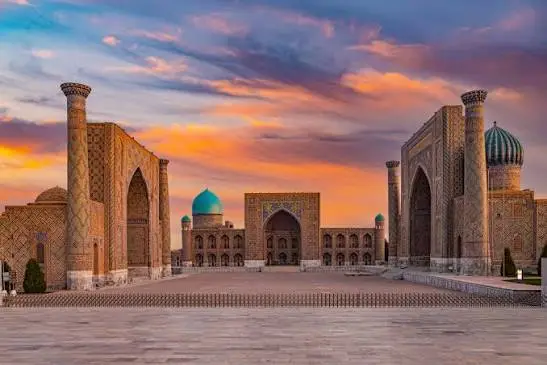
Samarkand is one of the oldest cities in the world and the capital of Amir Timur. Its monuments are on a scale that few places can match. The Registan, with its three madrasahs facing a vast square, is the most famous view in Central Asia. The Shah-i-Zinda, a street of mausoleums covered in turquoise and blue tiles, is often called the most beautiful place in Uzbekistan. The Gur-Emir, Timur’s tomb, glows gold inside, and the ruins of the Bibi-Khanym mosque show the ambition of his empire.
Around these monuments, Samarkand is a large, modern city with wide avenues, a 19th-century Russian quarter and busy traffic. The great sights are a little spread out, so you will walk between some and take short taxi rides to others, such as the Ulugbek observatory or the ancient site of Afrosiyob.
Bukhara, the living old town
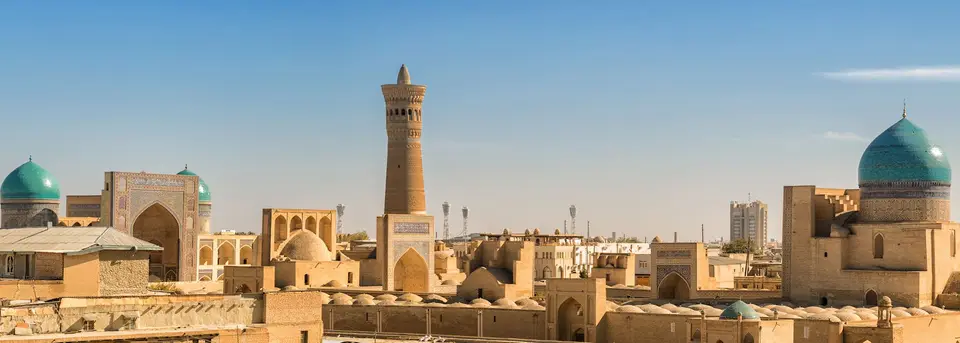
Bukhara feels different. Its historic centre is a maze of lanes, domes, madrasahs and mosques, where people still live, work and pray. The Poi-Kalyan ensemble, with the 12th-century Kalyan minaret, the great mosque and the Mir-i-Arab madrasah, is the heart of the city. Under the medieval trading domes, craftsmen sell carpets, suzani, knives and miniatures. The Ark fortress recalls the emirs, and the tiny Samanid mausoleum is one of the oldest Islamic monuments in Central Asia.
In the evening, life gathers around the Lyabi-Hauz, an old pool shaded by mulberry trees, with teahouses and restaurants. Bukhara rewards slow wandering more than ticking off sights.
Atmosphere
Samarkand impresses: you stand in front of the Registan and feel small. But between the monuments, the city is busy and modern, and the great sights can feel a little separated from daily life, especially since restoration and new developments around them.
Bukhara charms: you can walk everywhere, get lost in quiet lanes, and stumble on a small mosque or a family courtyard. In the evenings it is calm and atmospheric. For many travellers, Bukhara is the place where they feel they have stepped back in time.
Food and drink
Both cities have excellent food. Samarkand is famous for its heavy, shiny bread, its style of plov cooked in layers, and its wine; the Siab bazaar is one of the best in the country. See Samarkand food.
Bukhara has its own plov, oshi sofi and green bakhsh, and many restaurants with terraces and rooftop views. Dinner by the Lyabi-Hauz pool is a classic. See Bukhara food and Uzbek dishes.
Shopping and crafts
Bukhara is the better place for shopping: the trading domes and madrasah courtyards are full of workshops selling suzani, carpets, metalwork, miniatures and ceramics, and you can watch artisans at work. See shopping in Bukhara.
Samarkand is known for silk paper at the Konigil paper mill, silk carpets and the Sunday bazaar of Urgut nearby. See shopping in Samarkand.
Getting there
Samarkand is about 2–2.5 hours from Tashkent by Afrosiyob train and has an international airport, making it the easiest of the great cities to reach. See Tashkent to Samarkand and Samarkand airport.
Bukhara is about 4 hours from Tashkent by train, 1.5 hours from Samarkand, and has an airport close to the old town. It is also the starting point for the desert crossing to Khiva. See Tashkent to Bukhara and Bukhara to Khiva.
Who should choose which?
Choose Samarkand if:
- You have only one or two days and want the most iconic sights.
- You love grand architecture, tilework and the story of Timur.
- You are arriving from Tashkent and want an easy trip.
Choose Bukhara if:
- You prefer atmosphere, small lanes and evenings in teahouses.
- You want to shop for crafts and watch artisans.
- You plan to continue to Khiva across the desert.
See both if you have three days or more. A classic plan: Tashkent → Samarkand (2 nights) → Bukhara (2 nights) → Khiva. See our 3-day itinerary and 7-day itinerary.
Our view
We are based in Khiva, so we have no favourite between these two. Samarkand gives you the "wow", Bukhara gives you the feeling. If you can only choose one for a short stopover from Tashkent, Samarkand is easier. If you are building a longer trip and want to understand how people lived on the Silk Road, Bukhara is unmissable. And if you have time for both, you will understand why travellers have praised them for a thousand years.
Also deciding about Khiva? Read Khiva or Bukhara.
Day trips from each city
From Samarkand, popular day trips include Shakhrisabz, Timur’s birthplace, over the Takhtakaracha pass; the Imam al-Bukhari complex; the Urgut bazaar on Sundays; and the Konigil paper mill. From Bukhara, you can visit the Bahauddin Naqshband shrine, the summer palace of the emirs, the Chor-Bakr necropolis, and the ceramic workshops of Gijduvan. Both cities can also be the starting point for a night in a desert yurt camp near Lake Aydarkul.
Practical comparison
Hotels in both cities range from family guesthouses to large modern hotels; Bukhara has more atmospheric guesthouses inside the old town, while Samarkand has more large hotels. Both have ATMs, pharmacies and good mobile coverage.
One more tip
Whichever you choose, plan your visits to the main monuments early in the morning or late in the afternoon. You will avoid the large groups and the midday heat, and the light on the tiles is much more beautiful.
Frequently asked questions
Is Samarkand or Bukhara better for a first trip?
Both are excellent. Samarkand has the most iconic monuments; Bukhara has the most atmospheric old town. Most first trips include both.
How far is Bukhara from Samarkand?
About 270 km, 1.5 hours by Afrosiyob train or about 4 hours by car.
How many days do you need in Samarkand and Bukhara?
Two to three days in each, or one full day each on a short trip.